
How to combine sales, rentals, services and CRM in one e-commerce system

If a company sells products, offers rentals and accepts service requests at the same time, the classic “product → cart → payment” model is often not enough.
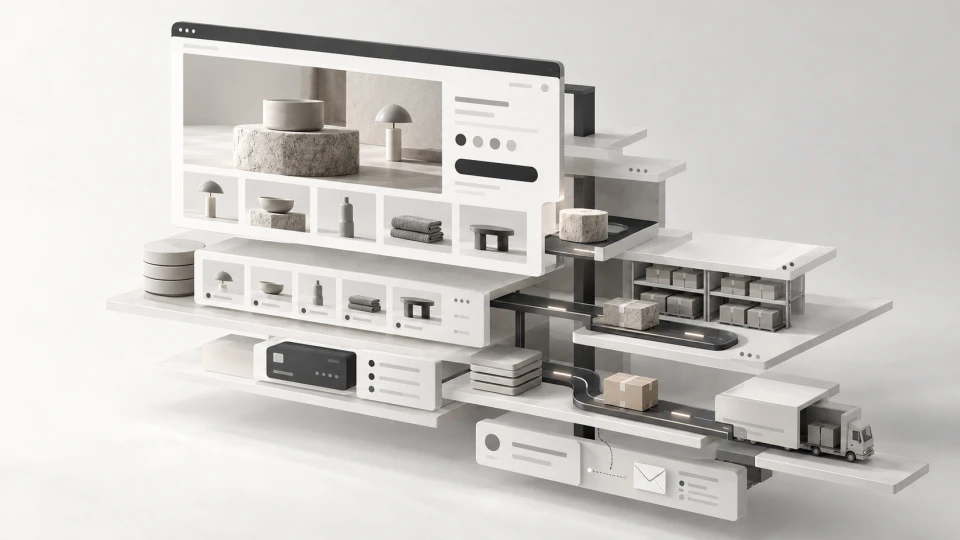
The main challenge is not building each feature separately. The harder part is making products, rentals, services, payments, CRM and customer communication work as one system.
The key question in a project like this is: do the different business processes look like one clear journey to the customer, and does the company team avoid having to move data manually between several systems afterwards?
If a customer has to use several separate forms, carts or systems to complete one task, the problem is often not the design - it is the process architecture.
As a real-life example, let’s look at Vedam - a moving services company for which Brandsite combined moving service requests, product purchases, box rental, online payments, CRM integration, Google API and automated customer communication in a single e-commerce solution.
~ 10min
08/10/2026
What did the Vedam solution bring together in one system?
Vedam needed more than a typical online store.
Several interconnected customer and business processes were combined in a single web solution:
- moving service requests;
- moving box rental;
- purchase of packing and moving supplies;
- combining rental and purchase products in one cart;
- choice of delivery or in-store pickup;
- online payments;
- CRM integration;
- Google API for address entry;
- automated email communication;
- management of product, order and payment statuses.
The solution was built on WordPress, development took around four months, and the website is available in Latvian, English and Russian.
The starting point: one company, several sales processes
The business model of a moving company is not a classic e-commerce scenario.
Some customers need a full moving service. Others only want to rent moving boxes. Others still need packing materials they can buy.
These scenarios also overlap.
A customer who books a move may want to rent boxes and buy packing materials in the same process.
That is why the solution had to connect several processes into one customer journey.
| Process | What the customer needs to be able to do | What happens on the company side |
|---|---|---|
| Moving service | Request a move and specify addresses, date and needs | Request data is passed on to the sales and customer service process |
| Product purchase | Choose and buy packing and moving supplies | The order, payment and status are managed in the system |
| Box rental | Choose rental products and add them to the order | Rental terms, availability and the return process must be taken into account |
| One cart | Combine purchase and rental products in a single order | The system must handle different product types |
| Delivery / pickup | Choose the most suitable way to receive the order | The information is passed on to order fulfilment |
| CRM | No additional steps required from the customer | Request and customer data are used further in the sales process |
| Automated communication | Receive confirmations and information about next steps | Emails are triggered by specific actions |
The main challenge was to make sure these processes did not look like a collection of separate systems to the customer.

Why typical online store logic is not enough here
In classic e-commerce, the product journey is often fairly simple:
product → quantity → price → cart → payment
A rental product follows different logic.
The product is not sold to the customer permanently - it is handed over for use for a set period and then returned.
So it is not just the price that matters, but also:
- product type;
- rental terms;
- availability;
- delivery or pickup;
- order status;
- return process.
Still, these technical differences should not make the purchase harder for the customer. This is where a well-planned user experience (UX) makes the difference.
How to combine sales, rentals and services in one system
Rental and purchase in one cart
For Vedam, we built custom WooCommerce e-commerce logic that lets customers combine rental and purchase products in a single cart and complete them as a single order.
A customer preparing to move may need rental moving boxes, cardboard boxes, stretch wrap and other packing materials at the same time.
If rental and purchase were completely separate processes, the customer would have to place several orders.
Service requests in the same digital environment
Vedam’s core service is moving, so one part of the project was a custom moving request form.
The customer can specify the services they need, the addresses and the preferred date.
As a result, several conversion paths work within one website:
moving service → request
box rental → booking or order
products → online store purchase
From the customer’s perspective, it is one Vedam environment rather than three unrelated digital solutions.
CRM integration and passing data to the sales process
The purchase or request process the customer sees is only one part of the system.
The other part begins on the company side.
The Vedam solution includes CRM integration that helps connect customer information collected on the website with the subsequent sales and customer service process.
Before integrating a CRM, it is important to define three things:
- What data is sent?
- At what moment is it sent?
- What does the company team need to do with it next?
For example, a service request can pass the customer’s contact details, addresses, selected service and request status to the CRM.
This makes it possible to continue the sales process without manually re-entering data from a form into another system.
It is the data flow - not the “CRM integration” label itself - that determines the practical value of an integration.
Google API for address entry
In a moving service, the address is not just contact information - it is part of the service itself.
The customer needs to specify where their belongings are moved from and where they should be delivered.
The Vedam project uses the Google API for address entry, so addresses can be entered more easily and more accurately.
Inaccurately entered data can create extra manual work and affect how the service itself is organised.
Automated customer communication
After a purchase or service request, the customer needs to know what happens next.
The Vedam solution includes automated email communication. It can relate to:
- order confirmation;
- payment status;
- service request;
- order fulfilment;
- further customer communication.
Communication is triggered by a specific action in the system, so the company team does not have to start every notification manually.
Additional product offers along the customer journey
A moving service naturally connects with box rental and the purchase of packing materials.
A customer planning a move may also need boxes, stretch wrap or other materials.
A good add-on offer is not a random upsell. It should continue the customer’s specific task.
In that case, the additional product helps the customer complete the same task rather than simply trying to increase the cart value.
Does your e-commerce business need custom logic?
Ask yourself four questions:
- Does the customer need to combine different types of products or services in one order?
- Does data have to be manually re-entered into a CRM or another system after an order?
- Do different products have different delivery, rental or fulfilment logic?
- Does the customer have to use several separate forms or systems to solve a single need?
If the answer to several of these questions is “yes”, the problem is probably no longer just the online store configuration.
Then you need to look at the system architecture and data flow itself. In some cases, a web application is the better fit - read more in When does a business need a web application?
Why the admin environment matters as much as the customer experience
In e-commerce projects, most attention usually goes to what the shopper sees.
But the solution also has to be easy for the company team to manage.
In the Vedam admin environment, the team can:
- edit content;
- manage products;
- track orders;
- manage payment statuses.
If every change to content, products, orders or statuses requires a developer, maintaining the system becomes unnecessarily expensive and slow.
A good online store is not only convenient for the shopper. It also has to be manageable for the company team.
What does the full customer and data flow look like?
In simplified form, the Vedam solution can be shown as two parallel flows.
Service path
Moving service
↓
Request form + Google API for addresses
↓
Customer data / CRM
↓
Further sales and customer service process
E-commerce path
Purchase products + rental products
↓
One cart
↓
Delivery or in-store pickup
↓
Online payment
↓
Order
↓
Admin environment + automated communication
This is one of the key lessons of the project: the customer interface is only the visible part. Behind it, there also needs to be a well-organised flow of data and business processes.

What can other e-commerce businesses learn from the Vedam project?
The Vedam example is especially relevant for companies whose business model is not the classic “product → cart → purchase”.
Before development, it is worth answering five questions:
- What does the customer buy, rent or request?
- What does the customer need to be able to combine in one order?
- Which data needs to be passed to a CRM or another system?
- Which actions on the company side can be automated?
- How will the company team manage the system day to day?
These questions help clarify the required system logic before a specific technology is chosen. For budget planning, see also How much does e-commerce website development cost in Latvia in 2026?
For a broader look at planning an e-commerce project, see the article How to build an online store in 2026: a practical guide for businesses.

Frequently asked questions
Can one online store combine sales and rentals?
Yes. The Vedam example shows that rental and purchase products can be combined in one e-commerce environment and completed in a single order.
The specific technical logic depends on the rental model and the company’s processes.
Can an online store be connected to a CRM?
Yes. CRM integration can help pass customer and request data collected on the website on to the sales or customer service process.
It is important to define in advance what data is passed on, at what moment and how it will be used next.
Does rental require a separate system?
Not always.
If the rental process fits the overall e-commerce architecture, sales and rentals can be combined in one solution.
More complex rental models may require custom business logic or integration with an external system.
Can services and an online store be combined on one website?
Yes. In Vedam’s case, moving service requests, product sales and box rental all work within one website.
How to find out what solution your business needs
If your e-commerce needs to combine products, rentals, services, a CRM or other business systems, choosing the technology is not the first step.
First, plan:
- the customer journey;
- product and service types;
- the data flow;
- integrations;
- what happens on the company side after the customer takes action.
Brandsite helps companies turn these processes into a unified e-commerce solution rather than a collection of separate plugins and manual tasks.
Latest articles
How to Build an Online Store in 2026: A Practical Guide for Businesses

When does a business need a web application?

How much does e-commerce website development cost in Latvia in 2026?