What Is Conversion Rate Optimisation (CRO)?

Conversion rate optimisation, or CRO, is a systematic process that aims to get a larger share of a website's or online store's visitors to take the desired action.
In e-commerce, this is most often making a purchase.
On a service company's website, it may be:
- filling in an enquiry form;
- booking a consultation;
- a phone call;
- requesting a quote.
CRO is not just a design change.
It combines:
data → user behaviour → identifying UX problems → hypotheses → changes → checking results
The goal is not just to get more traffic, but to get more results from the traffic the website already has.
~ 9min
10/11/2026
What is a conversion?
A conversion is an action the company wants the user to take.
In an online store, the main conversion is usually:
a purchase
On a service website, it may be:
- submitting an enquiry;
- booking a consultation;
- a phone call;
- a demo request.
On the way to the main conversion, there may also be intermediate actions, or micro-conversions, for example:
- viewing a product;
- adding a product to the cart;
- starting checkout;
- creating an account;
- signing up for a newsletter.
These actions help you understand at which stage of the user journey a problem occurs.
That is why, before starting CRO, you first need to answer:
what exactly counts as a successful result on this page?
How is the conversion rate calculated?
The simplified formula is:
Conversion rate = number of conversions ÷ number of visitors × 100
For example:
1,000 people visit an online store and 25 of them make a purchase.
25 ÷ 1,000 × 100 = 2.5%
The conversion rate is 2.5%.
In practice, it is important to use one measurement method consistently.
Depending on the analytics system, you may be measuring:
- users;
- sessions;
- purchases;
- enquiries;
- other actions that matter to the business.
That is why conversion rates from different companies cannot always be compared like for like.
What does CRO optimise in practice?
Conversion rate optimisation can affect almost the entire user journey.
In an online store
For example:
- category structure;
- product filters;
- product pages;
- price and delivery information;
- CTAs;
- the cart;
- checkout;
- payment options;
- the mobile version.
On a service website
For example:
- the service description;
- CTA placement;
- the contact form;
- pricing or process information;
- client examples;
- navigation;
- the enquiry process.
The goal of CRO is not to change everything.
The goal is to find the places where users get confused, hesitate or abandon the process, and understand what can be improved.
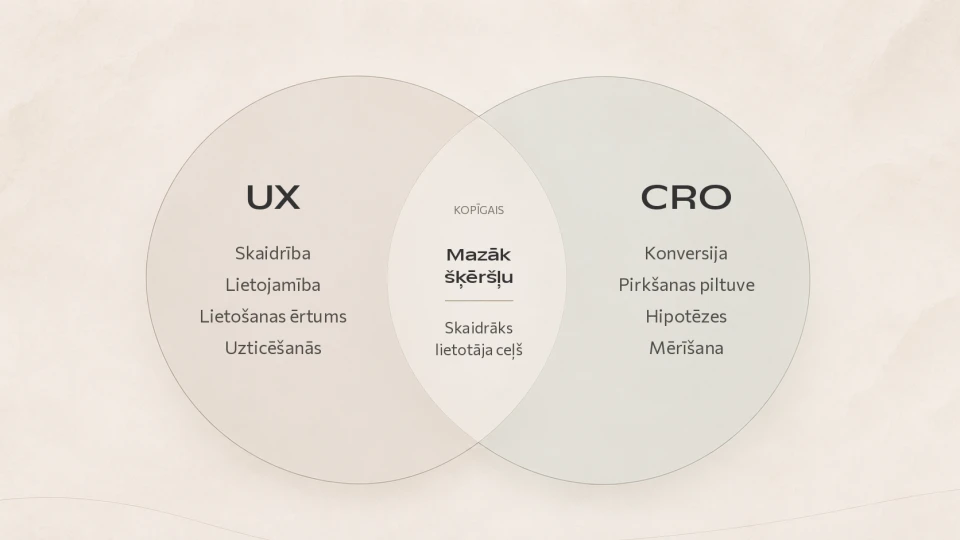
CRO vs UX - what is the difference?
User experience, or UX, looks at how clear, convenient and logical it is for a person to use a website or system.
CRO, on the other hand, looks at whether that experience helps the user reach a specific business result.
For example, an online store may have a visually polished product page.
But if the user cannot quickly understand:
- how much delivery costs;
- when the product will be available;
- whether the item can be returned;
- which size is the right choice,
they may not complete the purchase.
In that case, a single problem is both:
a UX problem, because the information is not clear enough,
and
a CRO problem, because the uncertainty reduces the chance that the user will buy.
That is why good conversion optimisation often starts not with changing the colour of a CTA, but with understanding the user journey and its obstacles.
A similar situation can occur on a service page when there are many visits but few enquiries, because the service process, the price or the next step is unclear.
A CRO example in an online store
Let's say an online store has:
10,000 visits a month
and
200 purchases.
The conversion rate is 2%.
The company could try to increase its advertising budget and get even more traffic.
But first, it can check why some of its existing visitors are not buying.
The analysis shows:
1,000 people add a product to the cart
→ 600 start checkout
→ 200 complete the purchase
This suggests that the biggest problem may not be on the product page.
It may be in the checkout stage.
For example:
- the delivery price appears only at the end;
- the form is too long;
- entering an address on mobile is awkward;
- the buyer's preferred payment method is missing;
- the error message is unclear.
The task of CRO is then to identify this obstacle and test whether removing it improves the result.
Read more about e-commerce structure, checkout, payments and integrations in our online store development guide.
How does conversion rate optimisation work?
CRO is a cyclical process.
1. Define the main conversion
For example:
a purchase
or
an enquiry
2. Analyse the data
Look at which stage of the user journey has the biggest drop-off.
For example:
product page → cart → checkout → purchase
3. Look for the reason
The numbers show where the problem is, but not always why.
That is why you use, for example:
- user tests;
- session recordings;
- heatmaps;
- surveys;
- customer support questions;
- UX analysis.
4. Form a hypothesis
For example:
If we show the delivery price earlier, fewer people will abandon checkout after seeing the delivery cost.
5. Implement and test the change
Depending on traffic and the situation, you can use:
- an A/B test;
- a before/after comparison;
- user testing;
- other controlled experiments.
If the change helps, you keep it. If it doesn't, you revise the hypothesis.
That is why CRO is a continuous optimisation process, not a one-off design tweak.
Does CRO mean A/B testing?
No.
A/B testing is one of the CRO methods, not CRO itself.
In an A/B test, the audience is split, for example:
Version A
the current product page
Version B
a product page with a restructured information layout
The results are then compared.
But A/B tests need enough data.
If a website has little traffic and only a few conversions a month, the test may not have enough data to draw a reliable conclusion.
In that case, the following may be more valuable:
- UX analysis;
- user testing;
- an analytics review;
- customer interviews;
- removing obvious obstacles.
CRO does not mean everything has to be tested with an A/B test.
What should not be done in the name of CRO?
Increasing conversions is not the only goal.
User trust matters too.
For example, in the short term you can boost certain metrics with:
- misleading CTAs;
- automatically added products;
- hidden costs;
- complicated opt-outs;
- intrusive pop-ups.
But this can damage:
- the customer experience;
- trust;
- repeat purchases;
- brand reputation.
That is why the goal of CRO is not to get a conversion at any cost.
The goal is to make the desired action clearer and simpler for a user for whom it is already relevant.
When does a business need CRO?
Conversion rate optimisation becomes especially valuable when:
- the website already has regular traffic;
- ads bring visitors, but there are few purchases or enquiries;
- many products are added to the cart but not bought;
- there is a high drop-off at checkout;
- people visit the service page but do not get in touch;
- the company is planning a website or online store redesign.
If there is very little traffic, CRO's ability to base decisions on data and experiments is more limited.
In that situation, a higher priority may be:
- attracting traffic;
- the offer;
- audience fit;
- SEO or advertising.
This does not mean that UX cannot be improved or obvious obstacles removed on a low-traffic site.
It will simply be harder to measure the impact of changes reliably.
Frequently asked questions
What is CRO?
CRO, or conversion rate optimisation, is a process that aims to increase the share of website visitors who take a desired action, such as making a purchase or submitting an enquiry.
What is a good conversion rate?
There is no single universal good conversion rate.
It varies by industry, traffic source, product price, device, market and type of conversion.
In practice, it is more useful to compare a company's results with its own previous period and similar segments than to aim for one universal percentage.
Is CRO the same as UX?
No.
UX focuses on the user experience, while CRO focuses on how that experience helps achieve a specific business result.
In practice, they often overlap, because unclear or complicated UX can reduce conversions.
Does CRO only help online stores?
No.
CRO can also be used for service websites, SaaS products, booking systems, landing pages and other digital environments.
The only thing that changes is what the company defines as a conversion.
Can conversions be improved without more traffic?
Yes.
That is exactly one of the goals of CRO - to get more purchases, enquiries or other results from existing traffic.
This does not mean attracting traffic is unimportant. CRO and customer acquisition work best together.
Summary
Conversion rate optimisation is the systematic improvement of a website or online store so that more users successfully complete the desired action.
CRO is not just:
button colours + CTA copy + A/B tests
It is a process:
data → user journey → obstacle → hypothesis → improvement → testing
And that is exactly why CRO is closely linked to UX.
Often, the best way to increase conversions is not to persuade the user harder, but to make their journey clearer, simpler and more trustworthy.
Latest articles

WooCommerce or Shopify: Which Is Better for the Latvian Market?
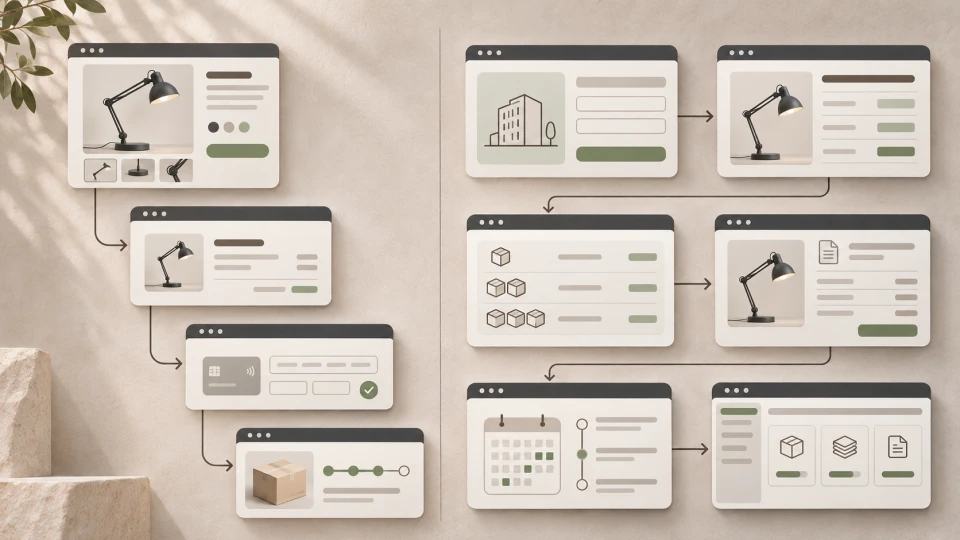
What Is B2B E-commerce?
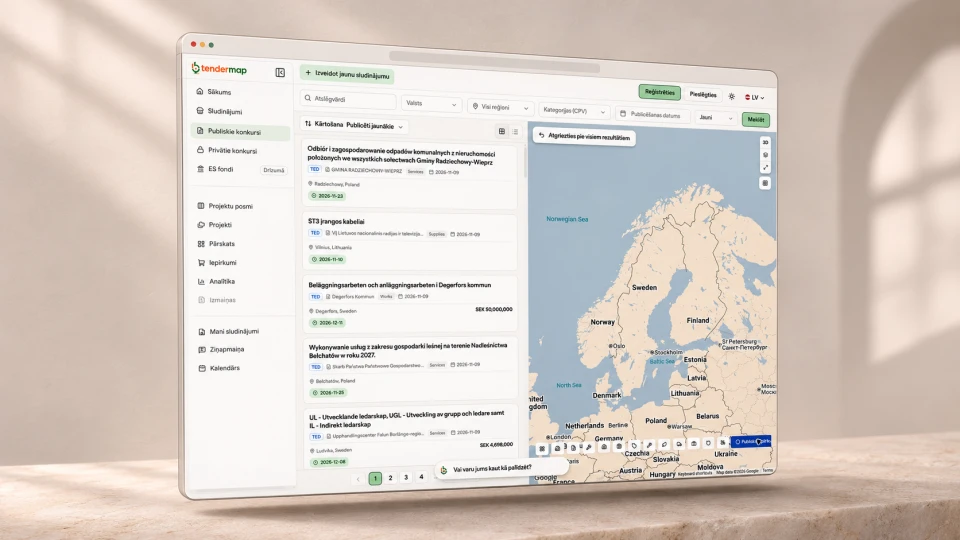
From Fragmented Construction Procurement to a Scalable Platform: The TenderMap Case