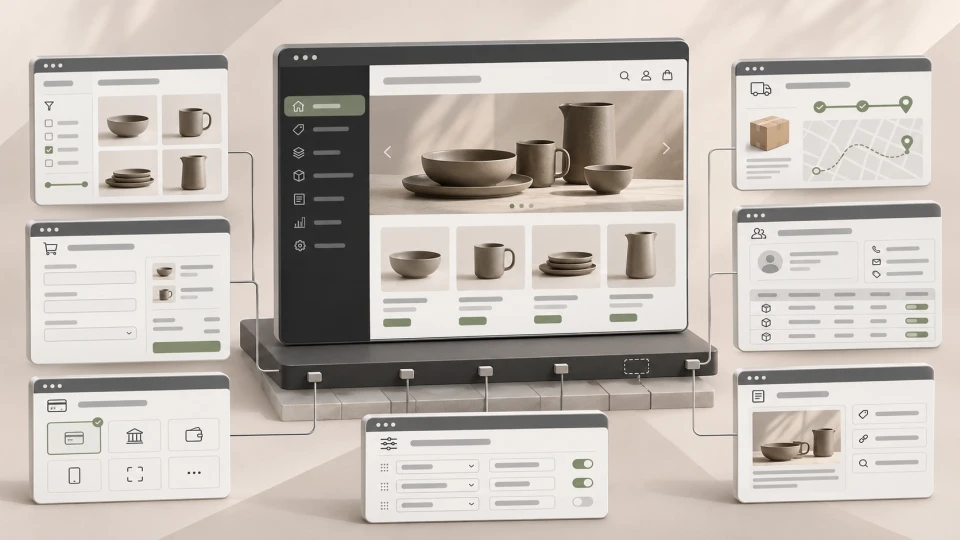
From Expert Knowledge to a Digital Product Platform: The HICE Group Case
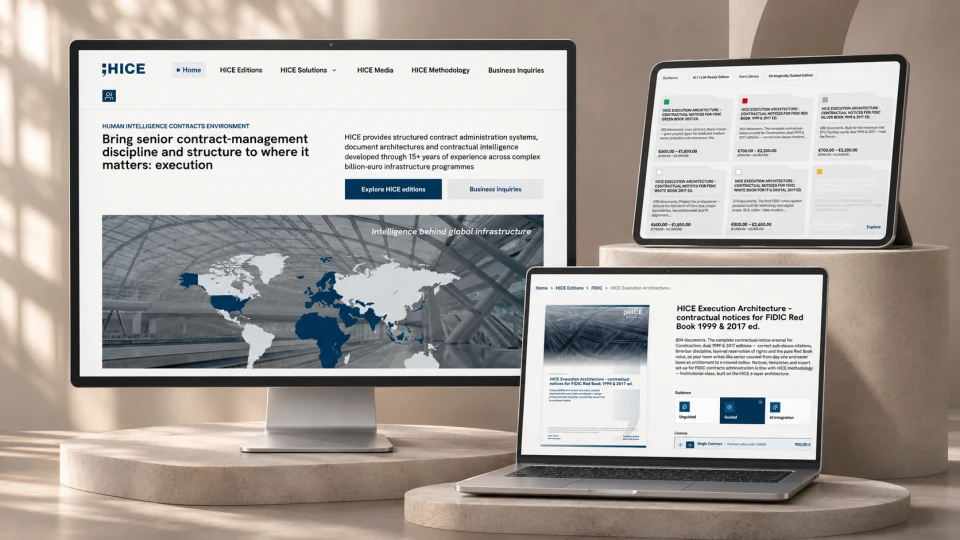
When selling digital products, it is not enough to simply put a PDF, methodology or other knowledge product into an online store.
If the offer is professional and complex, the customer first needs to understand:
what they are buying → who the product is for → how it differs from other products → what value it delivers → how they will receive it after purchase
This was exactly the task in the HICE Group project.
Brandsite built a unified digital platform for an international professional audience, combining:
brand identity → UX/UI design → digital product structure → WordPress e-commerce → protected product delivery → SEO
The main challenge was not just making the purchase technically possible.
It was necessary to turn complex expert knowledge into a clear, structured and purchasable digital product.
~ 8min
18/11/2026
HICE Group project results at a glance
The project resulted in a single environment that combines:
- custom UX/UI design;
- a structured system of digital products and bundles;
- self-service purchases;
- professional enquiry paths;
- protected digital product delivery;
- a WordPress e-commerce foundation;
- SEO and content structure for an international audience.
As a result, HICE Group got not just a "store for PDF files", but a system where professional knowledge can be structured, presented and sold as digital products.
The problem: expert knowledge is not a classic e-commerce product
With a physical product, it is often easier for the customer to understand what they are buying.
They can see:
- the product;
- an image;
- the size;
- the specification;
- the price;
- delivery.
With a professional digital product, the situation is different.
The customer needs to be able to understand:
- what problem the product helps solve;
- who it is for;
- what it includes;
- how detailed it is;
- how it differs from another resource;
- whether it fits their professional situation.
If this information is not structured, even high-quality expert content is hard to sell digitally.
That is why the HICE Group project did not start with checkout.
First, the product and offer logic had to be sorted out.
1. Product structure first, design second
One of the most important tasks of the project was to define how the products would be offered and sold.
The platform structure had to account for:
- individual digital products;
- product bundles;
- different customer journeys;
- self-service purchases;
- higher-value professional enquiries.
Not every customer has the same buying scenario.
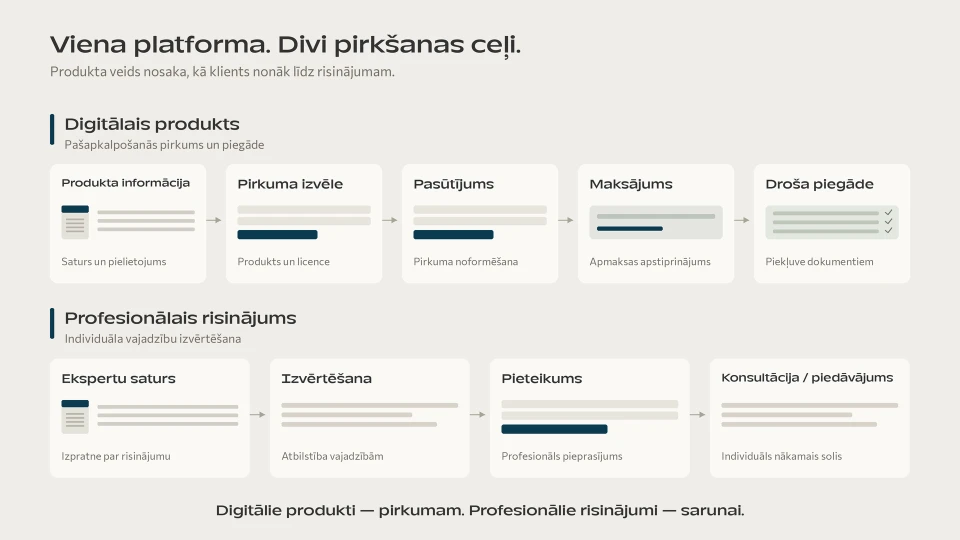
In one case, the journey may be:
product → information → purchase → digital delivery
In another:
expert content → trust → a more complex solution → professional enquiry
That is why, for HICE Group, information architecture was not just a design question.
It became part of the sales system.
2. Design had to help people understand and trust the offer
With digital knowledge products, the buyer evaluates not only the product itself but also its source.
This is especially important for a professional audience.
That is why the HICE Group project also included brand identity and custom UX/UI.
The design's task was to help a professional audience:
- quickly understand the product structure;
- tell different offers apart;
- find their way around the platform;
- trust the offer;
- reach the right purchase or contact path.
Here, visual design was not a separate "layer of beauty".
It helped make a complex offer easier to understand.
3. Digital products need a clear product architecture
In digital product e-commerce, product cards and a "Buy" button are not enough.
For HICE Group, it was important to help the customer understand:
What will I get?
Who is this product for?
Do I need one resource or a broader bundle?
How do the offers differ?
That is why the platform structured both individual digital products and bundles.
This makes a logical journey possible:
individual resource → related product → bundle → the most suitable offer
The goal is not just to display a catalogue.
The goal is to help the customer choose.
4. Digital product delivery is part of the purchase process itself
In physical e-commerce, delivery begins after the purchase.
In digital e-commerce, the product has to be delivered too.
On the HICE Group platform, the process can look like this:
product → checkout → payment → access to digital content
That is why the solution included protected digital product delivery.
The system needs to be able to link:
purchase → specific product → customer access
From the customer's perspective, the process should be simple.
From the company's perspective, access should be controlled.
5. One platform had to support different buying paths
Not all HICE Group offers are purchased the same way.
Some can be bought in self-service mode:
find → choose → pay → receive
A more complex or higher-value offer, on the other hand, may need a different path:
learn → evaluate → get in touch → clarify the need
That is why the platform took both scenarios into account.
This matters because in professional e-commerce it is not always right to force every offer into a single checkout model.
A digital platform should reflect how a specific product is actually bought.
6. WordPress e-commerce as the right foundation
The HICE Group solution was built on WordPress e-commerce.
This approach was a good fit because one system needed to bring together:
- digital products;
- product content;
- expert content;
- e-commerce;
- SEO;
- different sales paths.
The name WordPress itself is not what matters most.
The important question is:
does a ready-made e-commerce foundation solve most of the business process, while specific functionality can be customised?
For HICE Group, the answer was "yes".
That is why there was no need to program the entire system from scratch.
We explain this decision logic in more detail in What is WooCommerce in e-commerce development?
7. SEO was planned together with the product and content structure
The HICE Group platform was built for an international professional audience.
That is why SEO could not be added at the end of the project as:
meta title + meta description
SEO was tied to:
- product categories;
- product pages;
- expert content;
- information architecture;
- internal links;
- search intent.
This is especially important for digital knowledge products.
A potential customer doesn't always start with a specific product name.
They may start with a problem or a professional question.
So the journey can be:
problem → expert content → understanding → product → purchase
In this model, content and e-commerce work together in one customer journey.
What did the whole system look like?
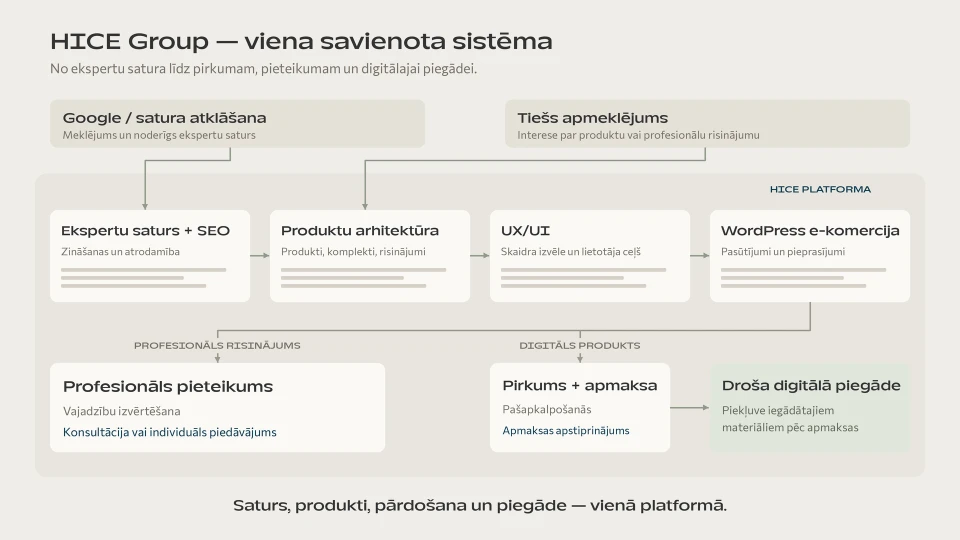
In simplified form, the logic of the HICE Group project can be shown like this:
expert knowledge
↓
structured product offer
↓
brand identity + UX/UI
↓
choice of product or bundle
↓
self-service purchase / professional enquiry
↓
digital product delivery
On the customer acquisition side:
Google / content
↓
expert topic
↓
product or solution page
↓
purchase or enquiry
This shows why a project like this is not just online store development.
It has to connect:
content + product + trust + sales process + technical delivery
in one system.
What can other companies learn from the HICE Group project?
The HICE Group example is especially relevant for companies that want to monetise:
- expert knowledge;
- methodologies;
- professional materials;
- research;
- documents;
- digital resources.
Before technical development, at least three things should be clear.
What exactly is the product?
Is the customer buying one material, a bundle or a broader professional solution?
How will the customer understand its value?
The product page needs to explain what the customer gets and who it is for.
What happens after the purchase?
Digital product delivery and customer access need to be clear.
For HICE Group, these questions were part of the platform architecture itself, not just a content task after development.
The result: one environment for the brand, content and digital sales
The result of the HICE Group project is a unified digital platform that brings together:
brand identity
→ custom UX/UI
→ WordPress e-commerce
→ digital products and bundles
→ protected product delivery
→ an SEO and content foundation for an international audience
The concrete result of Brandsite's development phase is a technical and commercial system in which professional knowledge can be structured and sold as digital products.
You can view the HICE Group project in the Brandsite portfolio.
Can your company's knowledge become a digital product?
If a company already has expert knowledge, methodologies or professional materials, the first question is not:
"What kind of online store do we need?"
First, you need to plan:
what we sell → who we sell to → how the customer understands the value → how they choose → how they buy → how they receive the product
Only then should you choose the technical solution.
See the wider e-commerce development process in our online store development guide.
Latest articles
Website Development Process: From Idea to Launch
UX/UI Design That Turns Visitors into Customers
7 E-commerce Automations That Help Win Back Customers and Increase Sales