What Is WooCommerce in E-commerce Development?
Updated: 12 November 2026
WooCommerce is an open-source e-commerce platform that runs on WordPress and provides the core functionality of an online store - products, cart, checkout, order management, payments and delivery.
In e-commerce development, WooCommerce lets you use a ready-made e-commerce foundation without programming the whole system from scratch.
It is particularly well suited to projects that need to combine:
online store + content + payments + delivery + integrations + custom functionality
But WooCommerce is not automatically the best solution for every project.
If e-commerce becomes just one feature in a much broader system with complex business logic, specific data flows or non-standard user processes, a custom-built solution, for example one based on Laravel, may be a better fit.
~ 8min
12/11/2026
What does WooCommerce bring to online store development?
WooCommerce provides a ready-made e-commerce model.
It includes, for example:
- products and categories;
- product variants;
- prices and promotions;
- stock levels;
- cart;
- checkout;
- customer accounts;
- orders;
- tax configuration;
- delivery;
- payment integrations.
This means you don't have to program the standard process from scratch:
product → cart → checkout → payment → order
Development resources can be spent on what is specific to the particular company:
- UX/UI customisation;
- custom features;
- integrations;
- automation;
- content structure;
- adapting business processes.
That is why, in many projects, WooCommerce is not simply a "ready-made online store" but a technical foundation that is tailored to a specific business.
WooCommerce is not just a ready-made theme
A WooCommerce project can be built at very different levels.
In one case, it may be:
ready-made theme + a few plugins + standard checkout
In another:
custom UX/UI design + WooCommerce + ERP + CRM + payment and delivery APIs + custom business logic
In both cases the platform is WooCommerce, but the quality and complexity of the final solution can be completely different.
That is why the phrase:
"the website is built on WooCommerce"
says little about the quality of the project on its own.
What matters is how the platform is built and adapted to the company's processes.
When is WooCommerce a good fit?
WooCommerce is often a good choice when the project is still centred on a clear e-commerce process, for example:
product → price → cart or quote → order → payment → delivery
and it needs additional features.
When content and SEO matter
If your SEO strategy relies on a broad content ecosystem, WordPress and WooCommerce are often a convenient foundation, because one environment lets you manage:
- products;
- categories;
- service pages;
- a blog;
- a glossary;
- buying guides;
- SEO landing pages.
The advantage here is not that WooCommerce automatically "ranks better".
The advantage is the flexibility of WordPress content architecture.
When you need payment, delivery and business system integrations
WooCommerce can be connected to:
- payment service providers;
- parcel lockers and couriers;
- ERP;
- CRM;
- warehouse systems;
- accounting;
- other APIs.
For example:
ERP → product prices
warehouse → stock levels
WooCommerce → order → ERP
new customer → CRM
Many common needs have ready-made solutions, while specific integrations can be developed individually.
When you need B2B/B2C functionality
WooCommerce can also be adapted to business customer processes.
For example:
- customer groups;
- individual prices;
- volume discounts;
- B2B accounts;
- prices for logged-in customers only;
- quote requests;
- different payment terms.
B2B functionality in itself is not a reason to switch to a custom platform.
If the process is still essentially:
product → price → order → payment or quote
WooCommerce can be an entirely justified solution.
Read more about choosing a platform, payments, delivery and integrations in our online store development guide.
When is WooCommerce no longer enough?
The most important criterion is not the number of products or orders.
The more important question is:
is the project still centred on an online store, or has e-commerce become just one feature in a much broader business system?
A custom solution, for example Laravel, may be more justified if you need:
- complex individual price calculations;
- non-standard order lifecycles;
- specific user roles and permissions;
- multi-vendor marketplace logic;
- complex approval processes;
- heavy data processing from several systems;
- a customer or partner platform where e-commerce is only one part.
In that case, trying to fit everything into the WooCommerce model can create more complications than benefits.
WooCommerce or a custom Laravel solution?
| WooCommerce is often a good fit if | A custom/Laravel solution may be a better fit if |
|---|---|
| The core is a classic e-commerce process | E-commerce is only one part of a larger system |
| You need a product catalogue and checkout | The buying process differs significantly from a standard checkout |
| WordPress content architecture matters | Custom business logic is at the centre of the system |
| You need standard payment and delivery integrations | You need very specific data flows |
| You need ERP/CRM integrations | There are complex multi-system processes |
| You need manageable B2B features | You need specific roles and approvals |
| Much of the functionality can rely on a ready-made e-commerce model | The standard e-commerce model starts to limit the system |
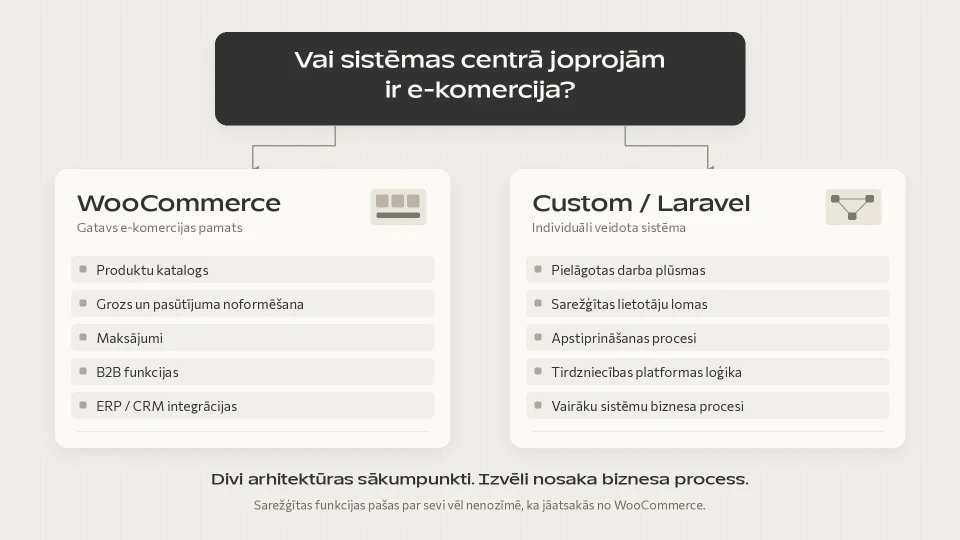
Laravel is not a "more powerful version" of WooCommerce.
They are different starting points.
WooCommerce starts with a ready-made e-commerce system that is adapted to the business.
Laravel starts with a web application framework on which the required system is built individually.
Does a large online store automatically mean WooCommerce won't work?
No.
The number of products or orders alone is not a sufficient criterion.
In new installations, WooCommerce uses High-Performance Order Storage (HPOS) by default, where order data is stored in dedicated database tables.
That is why the old argument:
"WooCommerce stores all orders as WordPress posts, so it can't scale"
is no longer accurate as a universal statement.
The configuration of existing stores may differ, and performance will still depend on:
- hosting;
- the database;
- product structure;
- integrations;
- plugins;
- the quality of custom code;
- caching;
- data volume;
- order flow.
A custom-built Laravel solution will not automatically be faster or more scalable just because it is custom either.
The technology should be chosen based on the system's requirements.
WooCommerce or Shopify?
WooCommerce is not the only ready-made e-commerce platform.
Shopify takes a different approach - a SaaS environment where the platform itself manages the infrastructure and much of the technical maintenance.
In simple terms:
WooCommerce
→ more technical control and WordPress flexibility
Shopify
→ a more standardised SaaS environment and less infrastructure maintenance
Both platforms can be suitable for the Latvian market.
We compare them in more detail in WooCommerce or Shopify: which is better for the Latvian market?.
How much does a WooCommerce solution cost?
WooCommerce's core software is open source.
However:
WooCommerce being open source ≠ a professional online store is free.
Costs may include:
- UX/UI design;
- development;
- hosting;
- paid extensions;
- integrations;
- data migration;
- testing;
- technical maintenance.
That is why the platform should not be compared on licence price alone.
You need to look at:
development + recurring costs + maintenance + future customisation costs
Does WooCommerce need technical maintenance?
Yes.
In a WooCommerce environment, you need to maintain:
- WordPress;
- WooCommerce;
- plugins;
- the theme or custom code;
- hosting;
- the database;
- backups;
- security.
This is the other side of having more technical control.
The company gains more freedom, but someone has to take responsibility for the technical environment.
When would Brandsite choose WooCommerce?
We would choose WooCommerce when a ready-made e-commerce foundation solves most of the project's needs, while specific features can be added in a controlled way.
We would consider a custom solution when most of the essential system logic would have to be built individually around WooCommerce anyway.
So the key question is not:
"Is WooCommerce powerful enough?"
But:
"Is this system still fundamentally e-commerce?"
Frequently asked questions
What is WooCommerce?
WooCommerce is an open-source e-commerce platform for WordPress that lets you manage products, orders, checkout, payments and other online store functions.
Is WooCommerce suitable for a professional online store?
Yes.
WooCommerce can be used for both simple and heavily customised e-commerce projects.
The solution's architecture, development quality and maintenance matter more than the platform's name.
Is WooCommerce free?
WooCommerce's core software is open source, but building a professional online store is not free.
You need to budget for development, hosting, maintenance, integrations and any extensions you need.
Can WooCommerce be integrated with ERP and CRM?
Yes.
WooCommerce offers an API and other integration mechanisms that let you connect the store to ERP, CRM, warehouse, accounting and other business systems.
When should you choose Laravel instead of WooCommerce?
Laravel may be a better fit when the project is centred on a non-standard business system rather than a classic online store, and most of the essential functionality would have to be built individually.
Summary
WooCommerce is a ready-made and highly customisable e-commerce foundation on WordPress.
It is a good fit when most of the required process still follows the e-commerce model and only the specific business needs have to be developed individually.
However, if custom business logic becomes the centre of the system and e-commerce is just one of its functions, a custom solution may be a better fit.
That is why the choice should not be based on the size of the store alone.
The most important question is:
is this system still fundamentally e-commerce?