WooCommerce or Shopify: Which Is Better for the Latvian Market?

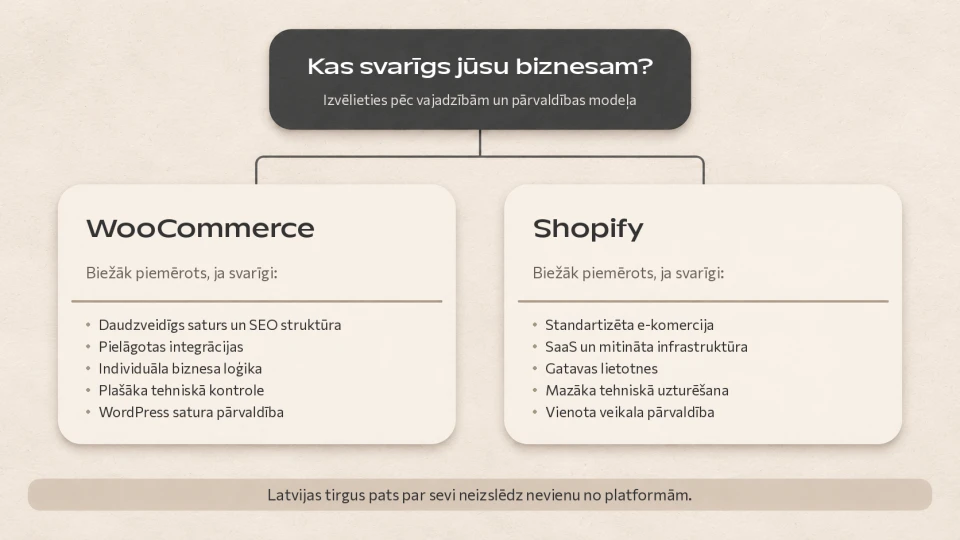
For a Latvian business, WooCommerce will more often be the better fit when content and SEO growth, custom integrations, tailored business logic and greater control over the technical solution matter. Shopify will more often be the better fit when you need a more standardised e-commerce environment, simpler technical maintenance, and most of your needs can be covered by Shopify's core features or ready-made apps.
Neither platform is automatically better for every Latvian business.
In 2026, it is also no longer accurate to rule out Shopify just because of the Latvian market - Shopify Payments is available in Latvia, and both platforms can be used for local as well as international e-commerce projects.
The choice depends more on:
- the business process;
- the integrations you need;
- your content and SEO strategy;
- multilingual requirements;
- technical maintenance;
- your long-term development plan.
~ 8min
10/11/2026
WooCommerce or Shopify - a quick comparison
| WooCommerce | Shopify | |
|---|---|---|
| Platform | Open-source e-commerce on WordPress | SaaS e-commerce platform |
| Hosting | Must be arranged separately | Included |
| Maintenance | The company's or developer's responsibility | Largely handled by Shopify |
| Customisation | Very flexible | Broad, within the platform's limits |
| Content and SEO | Very flexible WordPress content architecture | Full standard SEO capabilities |
| Payments in Latvia | WooPayments + third-party solutions | Shopify Payments + third-party solutions |
| Multilingual | Depends on the chosen WordPress solution | Shopify Markets + Translate & Adapt |
| Integrations | Extensive, custom solutions possible | Apps + Shopify API |
| Technical control | High | Lower |
| Fast launch | Depends on the project | Often simpler for a standardised store |
The key question is not:
"Which platform is better?"
But:
"Which platform better fits our sales process and growth plan?"
Key differences for a Latvian business
Payments in Latvia
In 2026, both platforms offer integrated payment solutions in Latvia.
Shopify Payments is available to Latvian businesses and supports, for example:
- Visa;
- Mastercard;
- American Express;
- Apple Pay;
- Google Pay;
- Shop Pay.
Shopify can also be used with third-party payment providers. In that case, you need to look at the total cost, because depending on the configuration and plan, a Shopify transaction fee may also apply.
WooPayments is also available in Latvia.
In addition, WooCommerce can be integrated with a range of other international and Baltic payment providers.
So in 2026, the main difference is no longer:
"which platform has payments in Latvia?"
Both do.
What matters more is assessing:
the cost model + the payment methods you need + freedom of integration + checkout logic.
If you need a standardised payment process, both platforms can be a good fit.
If you need specific payment logic or a combination of several systems, WooCommerce often gives you more freedom to customise.
VAT and selling in the European Union
Both WooCommerce and Shopify can be used for e-commerce in Latvia and other EU markets.
WooCommerce lets you configure:
- tax rates;
- prices with or without VAT;
- tax calculations based on the customer's location;
- B2B VAT scenarios with additional solutions.
For example, you can validate EU VAT numbers and, where appropriate, adjust how tax is applied to business customers.
Shopify also provides EU tax configuration and VAT registration management within its system.
Most importantly:
the platform itself does not determine a company's legal tax obligations.
If a company sells in several EU markets, has both B2B and B2C transactions or a more complex VAT structure, the tax process needs to be planned separately, regardless of the platform chosen.
Latvian and multiple markets
Both platforms can be used for a multilingual online store.
With WooCommerce, multilingual support is usually implemented with WordPress solutions, such as:
- WPML;
- Polylang;
- TranslatePress;
- other multilingual tools.
This allows flexible content in different languages for products, categories, blogs and other pages.
Shopify offers Markets and Translate & Adapt, which let you manage several languages and markets on one platform.
Keep in mind that not all third-party app content can always be translated with Shopify Translate & Adapt.
For a Latvian business that needs, for example:
LV + EN + RU
both platforms can be suitable.
WooCommerce's multilingual architecture can be configured very flexibly depending on the chosen WordPress solution, while Shopify offers a more centralised Markets approach.
SEO and content
SEO can be done on both platforms.
That is why it would not be accurate to say:
WooCommerce automatically ranks better than Shopify.
WooCommerce's advantage is something else.
Because it runs on WordPress, a single system can very flexibly combine:
products + categories + service pages + blog + glossary + custom landing pages
If a content ecosystem is a key part of the company's customer acquisition strategy, WordPress and WooCommerce often give greater content architecture flexibility.
Shopify also provides core SEO features, multilingual URLs, a market structure and the ability to optimise product, category and content pages.
So the difference is not:
good SEO versus bad SEO
but rather:
how broad and custom a content structure the company plans to build.
Integrations and custom business logic
Both platforms can be connected to other systems.
WooCommerce can be integrated with:
- ERP;
- CRM;
- warehouse systems;
- accounting;
- delivery systems;
- product data sources;
- custom APIs.
Because the solution is more open, the developer has more freedom to change how the system works to match a specific business process.
Shopify, on the other hand, has a very large app ecosystem and API.
Many typical needs can be solved with a ready-made app without custom programming.
So, in simple terms:
standard feature → Shopify is often convenient
custom business logic → WooCommerce often gives more flexibility
This does not mean complex solutions cannot be built with Shopify. You just need to assess whether the specific process can be implemented comfortably within the platform's architecture.
Maintenance and cost model
This is where the platforms differ significantly.
With WooCommerce, the company or its technical partner has to take care of:
- hosting;
- updates;
- backups;
- security;
- performance;
- plugin compatibility.
This gives more control, but also more technical responsibility.
Shopify largely manages this part of the infrastructure itself.
That makes the platform more convenient for companies that do not want to manage hosting and system updates separately.
Costs are also structured differently.
WooCommerce:
development + hosting + maintenance + licences/extensions
Shopify:
subscription + apps + payment costs + development/customisation
So you cannot compare:
WooCommerce = free
versus
Shopify = paid
It is more accurate to compare the total cost for a specific business over several years.
When to choose WooCommerce and when to choose Shopify?
| WooCommerce is often a better fit if | Shopify is often a better fit if |
|---|---|
| Content and SEO matter | You need a more standardised store |
| You need custom integrations | Ready-made apps cover most of your needs |
| You have custom business logic | There are few non-standard processes |
| You need more technical control | You don't want to manage hosting |
| WordPress is already the basis of your content | Simpler maintenance is the priority |
| You need flexible B2B/B2C logic | The main focus is selling products |
The Latvian market in itself is no longer a reason to rule out Shopify.
WooCommerce is not "the winner because it's Latvia".
It will more often be the better fit when a company needs more control, content, custom integrations and tailored business logic.
Shopify will more often be the better fit when the priority is standardisation, SaaS infrastructure and less technical maintenance.
We cover choosing a platform, payments, delivery and integrations in more detail in our online store development guide.
Frequently asked questions
Is WooCommerce better than Shopify?
Not always.
WooCommerce gives more freedom to customise the technical side and content, while Shopify offers a more standardised environment and simpler infrastructure maintenance.
The choice depends on the specific company's needs.
Does Shopify work in Latvia?
Yes.
Latvian businesses can use Shopify, and Shopify Payments is also available in Latvia.
Do WooCommerce and Shopify support payments in Latvia?
Yes.
Both platforms offer integrated payment solutions in Latvia, and both can also be connected to third-party payment providers.
WooPayments is available in Latvia, just like Shopify Payments.
Which platform is better for SEO?
Neither platform guarantees better Google rankings by itself.
WooCommerce and WordPress often give more flexibility for a broad content architecture and custom SEO solutions.
Shopify provides the standard SEO functionality needed for a high-quality e-commerce project.
Which platform is cheaper?
There is no universal answer.
WooCommerce costs are made up of development, hosting, maintenance and extensions.
Shopify costs are made up of the subscription, apps, payment processing and any development needed.
You need to compare the total cost of the specific project over several years.
Conclusion
WooCommerce and Shopify are both suitable for e-commerce in Latvia.
WooCommerce will more often be the better fit for a company that values control, content architecture, integrations and custom business logic.
Shopify will more often be the better fit when standardised infrastructure, simpler maintenance and an ecosystem of ready-made solutions matter.
That is why the choice should not be based only on the platform's popularity or initial price.
What matters more is understanding:
how the online store needs to work in one, two or five years.
Latest articles

What Is Conversion Rate Optimisation (CRO)?

What Is B2B E-commerce?
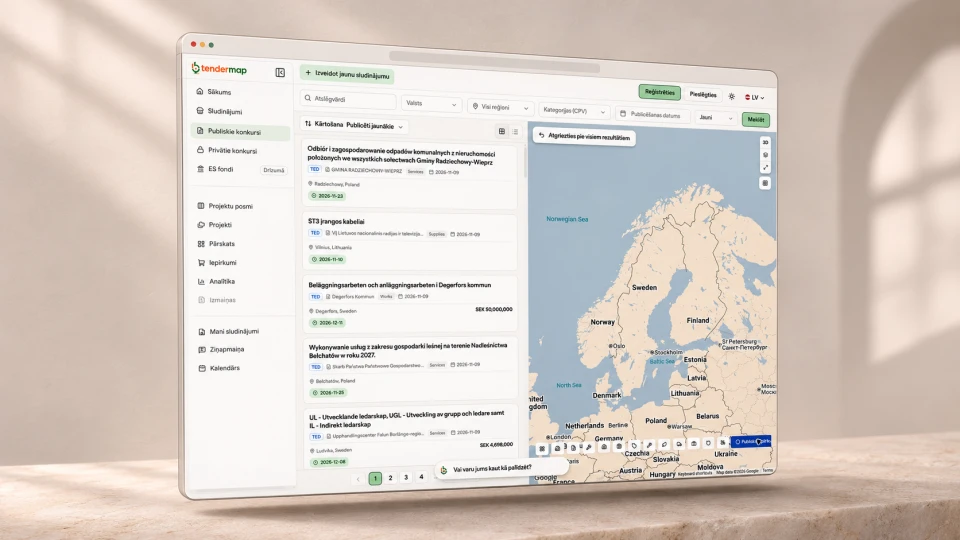
From Fragmented Construction Procurement to a Scalable Platform: The TenderMap Case