
How much does e-commerce website development cost in Latvia in 2026?

Brandsite e-commerce projects start from EUR 5,000.
The final cost is determined not only by the number of products or the platform selected. More importantly, it depends on how the online store needs to support sales and the company’s day-to-day business processes - from product discovery and checkout to warehouse data, customer communication, and process automation.
If you are planning a new project, you can learn more about Brandsite’s approach to e-commerce development.
~ 17min
22/09/2026
E-commerce development costs in 2026
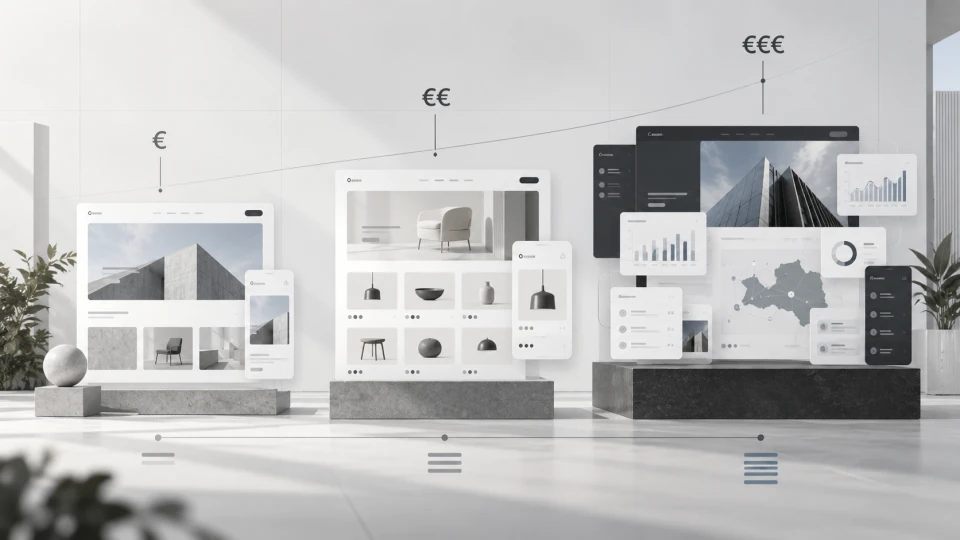
| Project level | Estimated budget | What it typically includes |
|---|---|---|
| Simple online store | ~EUR 2,000-5,000 | Small catalogue, standard payment and delivery options, ready-made or customized theme |
| Professional e-commerce solution | ~EUR 5,000-15,000 | More customized UX/UI, structured product catalogue, multiple languages, payments, delivery, analytics, and SEO foundations |
| E-commerce with business system integrations | ~EUR 10,000-25,000+ | ERP, CRM, warehouse systems, data synchronization, automation, and customized order logic |
| Custom e-commerce platform | from ~EUR 15,000 | Custom purchasing flows, B2B functionality, APIs, user roles, and individual business logic |
These are indicative project levels rather than a universal price list for the Latvian market.
What does Latvian market data show?
A 2026 GoTOP study analysed 38 Latvian web development providers. Fourteen of them publicly displayed an online store price, and the median published starting price among those companies was EUR 2,750. The lowest published starting price was EUR 1,000, while the highest was EUR 7,500. The authors of the study emphasize that these figures represent public starting prices rather than the final cost of completed projects.Coma, meanwhile, analysed 16 real written proposals submitted by 13 developers in 2025 for three specific WooCommerce projects. In this sample, the median price was approximately EUR 7,600 excluding VAT, while proposals ranged from EUR 2,400 to more than EUR 20,000. The project requirements included custom design, product filters, payment and delivery integrations, multiple languages, and performance optimization.
These two studies are not directly comparable. GoTOP analysed publicly advertised starting prices, while Coma reviewed actual proposals for specific projects.
That is why comparing e-commerce development prices requires looking not only at the final number, but also at what is actually being developed for that price.
Why does one online store cost EUR 3,000 while another costs EUR 15,000?
The main differences are often found behind the visible interface.
Product and category structure
A store with 20 products and one variation is a completely different technical project from a store with 5,000 products, multiple sizes, colours, attributes, prices, and stock levels.
Another important question is where the product data comes from. Products may be entered manually, imported from files, or synchronized automatically with an ERP or warehouse management system.
In real projects, product availability may also depend on several warehouses. For example, the Swim.lv e-commerce solution shows customers product availability for individual sizes across warehouses in Latvia and Estonia.
In this type of setup, a product page is no longer static content - it needs to display current business data.
UX/UI and product discovery
In e-commerce, design is not only about how the store looks.
The project needs to consider:
- category structure;
- search;
- filters;
- product cards;
- product pages;
- mobile experience;
- shopping cart;
- checkout;
- delivery and payment information.
The goal is to reduce unnecessary steps between discovering a product and completing a purchase.
Checkout and payments
A standard checkout process is one thing.
Development costs increase when the project requires:
- B2B pricing;
- different prices for different customer groups;
- individual discounts;
- deposits;
- subscriptions;
- gift cards;
- multiple payment scenarios;
- non-standard checkout steps;
- specific order approval processes.
The more closely the online store needs to reflect the company’s actual sales logic, the less the project is about configuring a ready-made platform and the more it becomes custom development.
Delivery integrations
Omniva, DPD, Venipak, courier delivery, in-store pickup, or individually calculated delivery prices can all become significant parts of an e-commerce project.
For example, the Addores project included an Omniva integration with automatic parcel shipment label generation, reducing manual work in order processing.
It is not enough to simply show customers a delivery option at checkout. The project also needs to consider what happens to the order after the purchase has been completed.
ERP, CRM and warehouse systems
As an e-commerce business grows, the online store often can no longer operate as an isolated system.
It may need to connect with:
- ERP;
- CRM;
- warehouse management systems;
- accounting;
- delivery providers;
- payment systems;
- product data sources;
- customer service systems.
For example, the Vedam solution combines moving service requests, box rental and purchases, online payments, CRM integration, Google API, and automated customer communication in one system.
The value of these business system integrations is not simply moving data between systems. The objective is to reduce manual work and create a unified process from the customer request through to order processing.
Email marketing and automation
Email marketing should ideally be planned during the online store development process.
An e-commerce platform can be connected to MailerLite, Brevo, Klaviyo, or another system used by the company to automate, for example:- welcome emails;
- abandoned cart flows;
- post-purchase communication;
- repeat purchase reminders;
- customer segmentation;
- personalized offers.
The Addores project included a Brevo integration for customer communication and automation.
This shows how sales, logistics, and ongoing customer communication can be planned as a single system rather than a collection of disconnected tools.
Product data feeds and external sales channels
E-commerce products do not always exist only within the online store itself.
Product data may also need to be distributed to:
- Google Merchant Center;
- price comparison websites;
- marketplaces;
- advertising platforms;
- business partners.
For example, the Bluetti project included XML product feeds for Salidzini.lv, 220.lv, and KurPirkt.lv.
In these projects, product data quality becomes especially important - including titles, prices, images, availability, and other attributes.
How to choose a platform for your online store?
It is more important to understand the business model, sales process, and functionality the company may need one or two years from now.
| Platform | Best suited for | Main advantage | Ongoing costs |
|---|---|---|---|
| Wix | Small and relatively simple e-commerce projects | Easy management and quick setup | Platform subscription |
| Shopify | Standardized SaaS e-commerce | E-commerce infrastructure and hosting in one platform | Subscription + apps + payment-related costs |
| WooCommerce | Businesses that prioritize content, SEO, and customization | High level of control and WordPress ecosystem | Hosting + licences + maintenance |
| Custom solution | Specific business logic | Maximum control over the system and data | Server infrastructure + technical maintenance |
There is no single platform that is best for every business.
For one company, Shopify may be the most cost-effective choice. For another, WooCommerce may offer significantly more flexibility. In more complex projects, a standard e-commerce platform may eventually become a limitation.
E-commerce development with WooCommerce: when should you choose it?
The core WooCommerce platform is free and open source. There is no fixed monthly WooCommerce platform subscription, but businesses need to plan for hosting, technical maintenance, and any paid extensions they require.
WooCommerce’s official pricing information currently states that hosting for many stores may cost approximately USD 25-350 per month, while paid extensions commonly cost around USD 29-299 per year per extension.
WooCommerce Advantages
1. Flexible product structure
WooCommerce can support both small product catalogues and more complex structures with categories, variations, attributes, and custom product types.
2. WordPress content capabilities
If a company relies on service pages, blogs, SEO landing pages, guides, or a wider content strategy, combining WooCommerce and WordPress allows content and e-commerce to be managed within the same environment.
3. Extensive integration possibilities
WooCommerce can be connected to payment systems, delivery providers, CRM, ERP, warehouse systems, email marketing tools, and other APIs.
4. Control over the technical solution
The business has greater freedom to choose its hosting, server infrastructure, and technical customizations.
5. Expandable functionality
The official WooCommerce Marketplace includes solutions for subscriptions, bookings, product bundles, gift cards, dynamic pricing, loyalty programmes, shipping, and automation.
In WooCommerce development, Brandsite chooses the platform when it matches the company’s actual requirements - not because we use one technology for every project.

What is usually included in the cost of e-commerce development?
| Often included in development | Often needs to be clarified separately |
|---|---|
| UX/UI design | Product photography |
| Responsive mobile version | Full product copywriting |
| Product and category structure | Bulk product entry |
| Checkout setup | Translations |
| Payment integration | ERP/CRM licences |
| Delivery integration | Paid plugins and applications |
| Technical SEO foundations | Long-term SEO |
| Analytics setup | Advertising budget |
| Testing and publication | New functionality after the initial project |
The fact that a specific task is not included in the initial proposal does not automatically mean that the proposal is poor.
What matters is that the project boundaries are clear before development begins.
What costs arise after the online store is published?
After publication, additional costs may include:
- platform subscriptions;
- hosting and servers;
- payment processing fees;
- WooCommerce plugins or Shopify apps;
- delivery integrations;
- CRM and ERP licences;
- email marketing platforms;
- product feed tools;
- backups and monitoring;
- website maintenance and support
- integration maintenance;
- SEO;
- product content;
- further functionality development.
So the right question is not only:
“How much does online store development cost?”
It is also important to understand:
“How much will this e-commerce system cost over the next 2-3 years?”
How much does e-commerce hosting cost?
A simple WooCommerce store may work well with quality managed hosting, while larger e-commerce projects with integrations and heavier data flows often require VPS or cloud infrastructure.
For these projects, server costs in Brandsite’s experience are often approximately EUR 25-100+ per month, depending on traffic, database requirements, catalogue size, caching, and the technical architecture.
You can read more about hosting, servers, and website maintenance costs in our guide to website development costs in 2026
When does a cheap online store become expensive?
Problems begin when, after a year, the company discovers that:
- the product structure is no longer scalable;
- the required ERP or warehouse integration cannot be added properly;
- the checkout cannot be adapted to the company’s process;
- the SEO structure needs to be rebuilt;
- the system depends on too many conflicting plugins;
- administration requires too much manual work;
- platform limitations make migration to another system necessary.
In these cases, a lower initial price may lead to redevelopment and higher overall costs.
That is why platform and architecture decisions should consider not only current functionality, but also the company’s future development plans.
When is custom e-commerce development necessary?
This may apply when the project requires:
- individual B2B pricing;
- different catalogues for different customers;
- synchronization between multiple warehouses;
- a specific checkout process;
- subscriptions;
- rentals;
- bookings;
- marketplace functionality;
- complex user roles;
- high-volume API data exchange;
- multiple interconnected business systems.
For example, the LightUp.lv B2B e-commerce solution included functionality that allows users to create product selections, generate them as PDF files, and send them to clients.
This is a practical tool for the daily workflows of interior designers and architects.
In the Masieru Akadēmija project, course registration, e-commerce, payments, and automated invoice processing were combined within a single WordPress solution.
Both examples demonstrate that custom functionality does not always mean developing a completely new platform from scratch. In some cases, the best solution is to adapt an existing technology to a specific business process.
If a standard e-commerce architecture is no longer suitable, the solution may evolve into a web application or a broader business system.
How to prepare an online store for SEO and AI Search visibility?
It is not only product page optimization that matters, but the entire information architecture:
- category and subcategory structure;
- indexable URLs;
- product names;
- product attributes;
- unique category content;
- product descriptions;
- internal links;
- structured product data;
- accurate pricing and availability;
- image optimization;
- product data feeds;
- Google Merchant Center;
- analytics and conversion tracking.
Google states that AI Overviews and AI Mode do not require any special “AI schema” or separate technical markup. The same fundamental SEO requirements continue to apply - an indexable website, high-quality content, clear internal structure, and information that Google can reliably process.
For e-commerce, Google also recommends using product structured data, while a Google Merchant Center feed can supplement website information with product pricing, availability, and other product data.
A more detailed technical review can also be carried out through an SEO audit and optimization.
In Brandsite projects, we focus on making sales, content, UX/UI, and technical functionality work together rather than treating them as separate parts of the project.
How can sales, rentals and CRM be combined in one e-commerce system?
The platform combines: moving service requests; product purchases; box rentals; delivery and pickup options; online payments; CRM integration; Google API address input; automated email communication; administration functionality and multiple language versions.
Customers do not need to use several disconnected systems, while the company’s team does not need to manually transfer information between different stages of the process.
View the Vedam project. It is also a good example of why two projects that can both be described as “online stores” may have completely different development scopes and budgets.
Where should you start when developing an online store?
The first step is understanding how e-commerce needs to work within the business.
1. What will you sell?
Physical products, digital products, services, rentals, subscriptions, or several models within one system?
2. What will the product structure look like?
How many products, categories, variations, and attributes will there be?
Will products require different prices, sizes, colours, or other parameters?
3. How will the purchase process work?
Which payment methods are required?
Should the customer pay immediately, submit a price request, or receive an individual quotation?
4. How will delivery work?
Parcel lockers, couriers, in-store pickup, specific delivery regions, or individually calculated delivery prices?
5. Which systems does the store need to connect with?
CRM, ERP, warehouse systems, accounting, delivery systems, email platforms, or other APIs?
6. Which markets will the business sell in?
Languages, currencies, VAT, delivery rules, and warehouse locations can significantly affect the project architecture.
7. How will customers find the store?
SEO, Google Shopping, Google Ads, Meta Ads, email marketing, and other channels should already be considered during the project structure planning stage.
8. What budget is available?
A budget is not only a limitation. It helps determine which features are essential in the first phase and which can be introduced later.
At Brandsite, we choose the platform based on business needs - not the other way around.
We evaluate the sales process, content, UX/UI, functionality, integrations, automation opportunities, and budget so the solution is suitable not only on the day it is published, but also for the company’s future growth.
How long does e-commerce development take?
In the GoTOP study, only seven companies publicly stated development times for online stores. Within this small sample, the median timeline was 56 days. The authors themselves emphasize that this should be treated as an indicator rather than a general standard for the Latvian market.
For professional Brandsite e-commerce projects, a typical development period is approximately 6-10 weeks, while more complex systems involving integrations or custom business logic may require several months.
The timeline is also significantly influenced by how early the following materials and decisions are prepared:
- product data;
- copy;
- photography;
- translations;
- access to external systems;
- API documentation;
- decisions regarding payments and delivery.
Therefore, an accurate project timeline can only be determined after the requirements have been evaluated.
Frequently asked questions
1. How much does a simple online store cost?
A simple online store built on an existing platform can be developed for a few thousand euros. The final price depends on the design, product structure, payments, delivery, and how much work the company handles internally. Brandsite e-commerce projects start from EUR 5,000.
2. How much does WooCommerce development cost?
The core WooCommerce platform is free, but the cost of developing a professional online store includes UX/UI, development, hosting, integrations, testing, and any necessary paid extensions. Therefore, the WooCommerce licence cost itself does not represent the total project cost.
3. WooCommerce or Shopify - which should you choose?
Shopify is suitable for businesses looking for a standardized SaaS environment with infrastructure already included. WooCommerce is often more suitable when WordPress content capabilities, SEO, broader customization, and greater control over the technical solution are important. The choice should be based on the specific needs of the business.
4. Is product entry included in the development price?
It depends on the project scope. A small number of products may be included in the development project, while large catalogue migrations, data cleaning, image processing, and product copywriting are often priced separately.
5. Can an online store be connected to an ERP or CRM?
Yes. An online store can be integrated with CRM, ERP, warehouse management, accounting, and other business systems if an appropriate API or another data exchange mechanism is available.
6. Can an online store be integrated with email marketing?
Yes. An e-commerce system can be connected to MailerLite, Brevo, Klaviyo, and other tools to automate welcome emails, abandoned cart communication, post-purchase flows, customer segmentation, and repeat sales.
7. How much does online store maintenance cost?
Costs depend on the platform and the complexity of the project. For WooCommerce, companies need to consider hosting, licences, updates, backups, and technical support. For Shopify, costs include the platform subscription and any applications used. An e-commerce project should be evaluated based on the total cost of the system, not only the initial development price.
8. When is a custom e-commerce solution necessary?
A custom solution is justified when a standard platform can no longer properly support the company’s business processes - for example, when specific B2B pricing, complex integrations, multiple warehouses, a non-standard checkout process, or individual user roles are required.
9. How long does e-commerce development take?
A professional e-commerce project often requires approximately 6-10 weeks. More complex platforms with several business system integrations may take several months to develop.
Planning a new online store?
Brandsite evaluates the product structure, sales process, UX/UI, integrations, automation opportunities, and available budget to select a solution that works not only for today’s requirements, but also for the company’s future growth.
Brandsite e-commerce projects start from EUR 5,000.
Book a consultation. Explore our e-commerce development service
Latest articles

How to combine sales, rentals, services and CRM in one e-commerce system
How to Build an Online Store in 2026: A Practical Guide for Businesses

When does a business need a web application?