
How much does website development cost in Latvia in 2026?
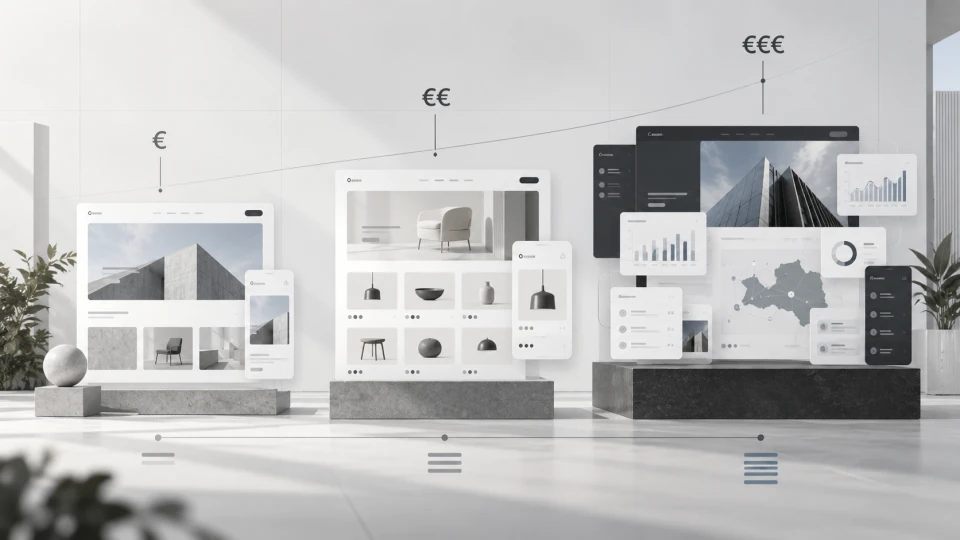
The most important question is not simply, “How much does a website cost?” but rather, “What should this web solution help the company achieve, and how much will it cost—not only during development but also in the years ahead?”
~ 19min
17/09/2026
Website development price guide for 2026
Therefore, the ranges below should be viewed as practical budget guidelines rather than a universal price list for the Latvian market.
| Budget range | What you can usually expect | Where the limitations begin |
|---|---|---|
| Up to approx. EUR 1,500 | A website builder, ready-made theme, or small standard website with limited customisation. | Custom UX/UI, complex integrations, extensive SEO work, and non-standard business logic are generally not the focus at this budget level. |
| Approx. EUR 1,500–5,000 | A small or medium-sized website with customisations, multiple content pages, and selected features. | The scope of work varies considerably depending on the design, content, languages, integrations, and what is included in the proposal. |
| Approx. EUR 5,000–15,000+ | A business website with strategy, custom UX/UI, a CMS, SEO foundations, analytics, multilingual functionality, and selected integrations. | The price increases when complex data exchange, non-standard functionality, or a large volume of content is required. |
| Approx. EUR 5,000–25,000+ | E-commerce—from a simple single-product website, digital service, or online course to a comprehensive online store with custom design, payments, delivery options, and integrations. | A simple single-product solution can be relatively compact, while ERP or warehouse integrations, multiple markets, large catalogues, subscriptions, and specific order-processing logic can significantly increase the budget. |
| From approx. EUR 15,000 | A web application, portal, or business system with users, roles, databases, APIs, and custom business logic. | The budget increases with user traffic, security requirements, data volume, integrations, and future scalability requirements. |
Important
Two proposals both described as a “business website” may be entirely incomparable. One may include a ready-made theme, five content pages, and a contact form. The other may include research, information architecture, custom UX/UI, multilingual functionality, an SEO structure, CRM integration, analytics, testing, and a maintenance plan.
Brandsite project starting budgets
| Project type | Brandsite projects from | What we typically deliver |
|---|---|---|
| Corporate website | EUR 3,000 | Website structure, custom UX/UI, CMS, multilingual functionality, SEO and analytics foundations, forms, and required integrations. |
| E-commerce solution | EUR 5,000 | From selling a single product, digital service, or online course to developing a product catalogue, checkout, payment and delivery functionality, analytics, and integrations. |
| Web application / business system | EUR 15,000 | Users and roles, databases, APIs, booking functionality, administration panels, workflows, and custom business logic. |
The starting price of EUR 5,000 for e-commerce is deliberately retained for simpler scenarios—for example, selling a single product, digital service, or online course without complex warehouse, ERP, or multi-market integrations. The budget will be higher for larger online stores with extensive catalogues, specific checkout logic, subscriptions, or system integrations.
Why does one website cost EUR 1,000 while another costs EUR 10,000?
1. Strategy, research, and information architecture
A simple project may begin with a ready-made list of pages. In a larger project, the business objectives, target audiences, sales journey, competitive landscape, content priorities, language structure, SEO topics, and technical requirements must be understood before the design process begins. This work is not visible as a separate “feature,” but it determines whether the website will be logical, discoverable, and scalable.
2. Custom UX/UI or a ready-made theme
A ready-made theme is faster and more affordable when it closely matches the company’s needs. Custom UX/UI design involves creating a tailored visual hierarchy, components, mobile layouts, forms, interface states, and user journeys. This requires more work, but it allows the solution to be adapted to the business rather than forcing the business to adapt to the theme.
3. Content and number of languages
Five content pages in one language and 30 service pages in three languages are not the same type of project. The scope must account for content structure, copywriting or editing, translations, images, data entry, metadata, and the amount of content the client’s team will need to manage after launch.
4. Functionality and integrations
A contact form is one feature. A CRM integration, booking system, price calculator, product synchronisation with a warehouse system, customer portal, payment processing, or ERP data exchange involves separate workflows, each with its own data, error scenarios, and testing requirements. The more business logic that needs to be developed behind the visible website, the greater the development scope.
5. SEO, analytics, and measurement
SEO is not simply about adding keywords to finished content. A high-quality project requires careful planning of the URL structure, heading hierarchy, internal links, indexing, metadata, performance, and analytics. If the SEO foundations are addressed only after the website has been launched, parts of its structure may need to be rebuilt.
The Roofmaster SEO project demonstrates how information architecture, a multilingual structure, market-specific content, and technical SEO can work together as one integrated system.
6. Testing, security, and technical quality
Before launch, the website should be tested for responsiveness, browser compatibility, forms, analytics events, payments, emails, integrations, performance, and SEO fundamentals. For an e-commerce solution or web application, the testing scope can be considerably greater than for an informational website.

What is usually included in the website development price, and what should be clarified separately?
| Often included in a professional project | Often needs to be clarified separately |
|---|---|
| Defining business objectives and technical requirements | Complete copywriting for all pages |
| Website structure and user journeys | Professional photography and video production |
| UX/UI design and responsive layouts | Translation and localisation |
| CMS setup or technical development | Paid plugins, fonts, SaaS tools, and other licences |
| Forms and predefined integrations | Third-party system subscription fees |
| Technical SEO foundations and metadata structure | Ongoing SEO, content production, and digital marketing |
| GA4/GTM setup and predefined conversion events | Advertising budget |
| Testing and website launch | Development of additional features beyond the original scope |
| Documented handover and training, where included | Hosting, domain registration, and technical maintenance, unless included in the proposal |
Practical rule
If two proposals differ in price, compare their scope first. The cheapest proposal is not automatically the most cost-effective, and the most expensive one is not automatically the best.
WordPress, WooCommerce, Wix, or Laravel - which should you choose?
| Solution | Cost level | Best suited for | What to consider |
|---|---|---|---|
| Wix / website builder | Low | A simple online presence, campaign landing pages, or testing an idea. | Quick to build, but the platform’s limitations may become noticeable as integration or data requirements grow. |
| WordPress + ready-made theme | Low to medium | A standard business website with simple functionality. | Faster and more affordable, but quality depends on the theme, plugins, and the extent of the required customisation. |
| Custom WordPress | Medium to high | Corporate, content-focused, and multilingual websites. | A strong choice when a manageable CMS, SEO, content, and a custom structure are priorities. |
| WooCommerce | Medium to high | E-commerce within the WordPress ecosystem. | The budget is significantly affected by the checkout process, product catalogue, payments, delivery, inventory management, and integrations. |
| Laravel / custom development | High | Web applications, portals, booking systems, and specific business logic. | A higher initial investment, but greater control over the architecture, data, and custom functionality. |
WordPress development is often suitable when the priorities are content, multilingual functionality, SEO, and easy administration. Laravel development or a customweb application is more appropriate when the project requires user roles, data processing, bookings, customer portals, APIs, or specific business logic.
WordPress is not automatically inexpensive. Laravel is not automatically better. The right choice is the technology that best matches the specific business objective and long-term development plan.
How much do a domain and hosting cost after a website is launched?
.lv domain costs
A standard .lv domain registration and one year of maintenance through NIC.LV currently costs EUR 12.00 excluding VAT or EUR 14.52 including 21% VAT.
Hosting costs depend on the project—not only on disk space
A high-quality shared or managed hosting plan may be sufficient for a simple WordPress website. For e-commerce, web applications, and custom systems, Brandsite more commonly uses VPS or managed cloud infrastructure.
Depending on the project, we may use an xCloud or Cloudways managed server environment, while DigitalOcean VPS servers can be managed by the Brandsite team on the client’s behalf. For business projects, a realistic server budget often starts at approximately EUR 25–100+ per month, depending on traffic, RAM and CPU requirements, databases, caching, backups, integrations, and system architecture.
| Project type | Typical infrastructure | Estimated budget |
|---|---|---|
| Small business WordPress website | Shared / managed hosting | Approx. EUR 5–25/month |
| Larger WordPress website | Managed hosting / VPS | Approx. EUR 15–50+/month |
| WooCommerce / e-commerce | VPS / managed cloud | Approx. EUR 25–100+/month |
| Web application / custom system | VPS / cloud infrastructure | Approx. EUR 25–100+/month; more for high-load projects |
| High-traffic or business-critical system | Scalable cloud / dedicated architecture | Custom pricing |
Nano, DigitalOcean, xCloud, and Cloudways - how hosting, VPS, and managed server environments differ
When comparing hosting options, it is important not to confuse an infrastructure provider with a server management platform. The options below address different needs, so the lowest price alone is not a sufficient basis for choosing between them.
| Service | Model | Public price / Brandsite’s practical budget as of 14 September 2026 | When it may be suitable |
|---|---|---|---|
| Nano | Latvian hosting and VPS provider; Brandsite partner | Shared hosting: EUR 4.50–32.50/month, including VAT. Public VPS plans from EUR 17.22/month. | Small WordPress websites, local hosting, and VPS projects. The specific plan is selected according to resource, security, and traffic requirements. |
| DigitalOcean | Cloud VPS / Droplets infrastructure; servers that Brandsite can manage for the client | 4 GB / 2 vCPU: USD 24 (approx. EUR 21); 8 GB / 4 vCPU: USD 48 (approx. EUR 42); 16 GB / 8 vCPU: USD 96 (approx. EUR 83). | E-commerce, Laravel, and web applications that require flexible VPS infrastructure with server management provided by Brandsite. |
| xCloud | Managed server and management layer; also available in a BYO VPS model | Approx. USD 25–100+/month (approx. EUR 22–87+) for typical Brandsite business projects. Public managed plans: USD 30 for 4 GB, USD 50 for 8 GB, and USD 100 for 16 GB. | WordPress, WooCommerce, Laravel, and other applications where the server and management layer are required within one service, including backups, staging, SSL, monitoring, and deployment tools. |
| Cloudways | Managed VPS / cloud platform | In Brandsite’s experience, approximately USD 14–100+/month (approx. EUR 12–87+), depending on resources; the publicly advertised entry price may be lower. | WordPress, WooCommerce, Laravel, and PHP projects that require a managed cloud environment with backups, staging, caching, and support. |
Brandsite’s note on Nano
Nano is one of the hosting partners we work with. If you choose Nano, you can use the Brandsite partner link. Yes, it is an affiliate link, and Brandsite may receive a partner benefit. We appreciate good hosting—and transparent partnerships too.
Hosting is not the same as website maintenance
Hosting provides server resources. Website maintenance may include CMS and plugin updates, backups, security checks, troubleshooting, monitoring, server configuration, a staging environment, performance improvements, and integration testing.
What costs may arise after launch?
| Cost item | How the cost arises | What to check in the proposal |
|---|---|---|
| Domain | Annual registration or renewal fee. | Who owns the domain and who manages it. |
| Hosting / server | Monthly or annual fee based on the required resources. | CPU, RAM, disk space, bandwidth, backups, SSL, server location, and scalability. |
| Technical maintenance | Regular monitoring, updates, and troubleshooting.Premium WordPress plugins, fonts, maps, cookie consent platforms, search tools, and similar services. | What is included, response times, and what is considered additional work. |
| Plugins and licences | Premium WordPress plugins, fonts, maps, cookie consent platforms, search tools, and similar services. | Whether the licences belong to the client or developer and how much renewals cost. |
| CRM / ERP / SaaS | External system subscriptions and user licences. | Whether the integration works with the existing plan and whether API access costs extra. |
| APIs and transactions | Maps, emails, SMS messages, payment gateways, AI APIs, delivery services, and similar tools. | Fees per request, transaction, message, or user. |
| Content and SEO | New landing pages, blog content, SEO audits, and optimisation. | Whether this is a one-off service or an ongoing process. |
| Ongoing development | New features, integrations, markets, or languages. | The hourly rate, sprint model, or whether a separate estimate will be required. |
A simple formula for a three-year budget: development + hosting + maintenance + licences + third-party services + ongoing development.

When does a cheap website become expensive?
- New languages or service sections cannot be added easily.
- The SEO structure was not planned, requiring URLs or the page hierarchy to be reworked later.
- The website relies on too many interdependent plugins.
- Adding integrations requires substantial redevelopment.
- The administration panel is difficult to use, and every change requires a developer.
- There is no staging environment, backup system, or clear responsibility for technical maintenance.
- It is unclear who owns the code, licences, domain, or third-party accounts.
- Performance or security issues begin to affect sales and advertising results.
In this situation, the company may end up paying twice: first for a solution that only meets today’s needs and then again to rebuild it once the business has grown.
How does functionality affect project cost? Three Brandsite examples
Smart Interior — a WordPress website with a price calculator
In the Smart Interior project, we developed a custom UX/UI design using a mobile-first approach, three language versions, a Planplace price calculator integration, a custom contact form with file uploads, automated emails, Google Analytics, Google Tag Manager, Meta Pixel, and on-site SEO foundations.
The price here is not determined solely by the number of pages. Part of the value lies in enabling visitors to calculate estimated costs and submit structured project information before the first conversation.
Ambercar — a booking system operating behind the website
Ambercar is a Laravel web application featuring dynamic pricing logic, real-time availability, bookings, loyalty features, payment and email integrations, an administration panel, and a Schedullbull API connection for managing the vehicle fleet and reservations.
To the user, it looks like a car rental website. Technically, however, it is supported by a much more extensive business system.
Vedam — e-commerce, rentals, and CRM in one platform
The Vedam project combines moving service requests, product purchases, box rentals, online payments, CRM integration, Google API address entry, and automated email communication within a single solution.
It demonstrates how an “online store” can also function as a rental, sales, and customer service system.
Conclusion
A project’s price is determined more accurately by the features, data flows, and business processes the solution must support—not by whether it is called a “website,” “online store,” or “platform.”
How to compare two website development proposals?
| Question | Why it matters |
|---|---|
| Does the price include research, website structure, and UX planning? | Without this stage, the design may solve the wrong problem. |
| Is the design custom-made or based on a ready-made theme? | These involve different scopes of work and offer different long-term possibilities. |
| Who prepares the copy, images, and translations? | Content is often not fully included in the development price. |
| Is SEO planned before development begins? | Reworking URLs, website structure, and content after launch can be more expensive. |
| Which integrations are specifically included? | CRM, ERP, warehouse systems, and APIs may represent a significant part of the project. |
| Are analytics and conversion tracking included? | Without data, it is difficult to determine the website’s value to the business. |
| What happens after launch? | Hosting, backups, maintenance, support, and warranty terms should be clearly defined. |
| Who owns the domain, code, design, and licences? | The company must retain control over its digital assets. |
| How many revision and approval rounds are included? | This affects both the timeline and the risk of additional costs. |
| How is additional work priced? | It is important to understand the hourly rate, sprint model, or approach to preparing separate estimates. |
What should you prepare before requesting a quote?
- The project’s business objective and the main problem the website should help solve.
- The primary target audiences and target markets.
- The approximate number of pages and languages.
- Required functionality, such as forms, bookings, calculators, user accounts, and e-commerce.
- Existing systems the website must connect to, such as CRM, ERP, inventory management, accounting, email, and payment systems.
- Information about who will prepare the copy, images, and translations.
- Existing SEO rankings and URLs if an existing website is being redesigned.
- The preferred launch date and any important business deadlines.
- A realistic budget range.
- The person or team responsible for making decisions and approving content.
How much does Brandsite website development cost?
Corporate websites — from EUR 3,500
E-commerce solutions — from EUR 5,000
Custom web applications and business systems — from EUR 15,000
A simple e-commerce solution may start from EUR 5,000—for example, when selling a single product, digital service, or online course without complex integrations. The budget will be higher for larger online stores with extensive product catalogues, ERP or warehouse integrations, multiple markets, subscriptions, or custom order-processing logic.
An accurate estimate can be prepared after assessing the project’s objectives, structure, functionality, design, content, integrations, and technical risks.
Frequently asked questions about website development costs
How much does a simple WordPress website cost?
In the Latvian market, a simple WordPress website based on a ready-made theme may cost anywhere from a few hundred euros to approximately EUR 1,500. However, the final price depends on the project scope. A custom WordPress website with UX/UI design, multilingual functionality, an SEO structure, and integrations involves a different level of work and usually costs several thousand euros.
How much does a professional business website cost?
The cost of a professional business website depends on whether the project includes custom design, content development, multiple languages, SEO, analytics, and integrations. Brandsite corporate website projects start from EUR 5,000.
How much does website hosting cost?
Hosting for a small WordPress website may cost anywhere from a few euros to a few dozen euros per month. For e-commerce and web applications, Brandsite more commonly uses VPS or cloud infrastructure costing approximately EUR 25–100+ per month, depending on traffic and technical requirements.
Are website hosting and maintenance the same thing?
No. Hosting provides the server environment. Maintenance may include updates, backups, security checks, troubleshooting, monitoring, a staging environment, performance improvements, and integration testing.
Is SEO included in website development?
It depends on the proposal. Brandsite projects include technical SEO foundations, such as URL and heading structures, metadata logic, a sitemap, robots.txt, indexing, and performance fundamentals. An in-depth SEO audit, content optimisation, and ongoing SEO development may be offered as separate services.
Which is more affordable—WordPress or Laravel?
For a standard business website, WordPress is usually more cost-effective. Laravel is better suited to projects requiring custom business logic, user roles, databases, booking functionality, APIs, or complex integrations.
How long does website development take?
Brandsite corporate website projects typically take approximately 4–8 weeks, while e-commerce projects often take 6–10 weeks. Custom web applications may require several months. The timeline is significantly affected by content readiness, the speed of approvals, and the complexity of integrations.
Why can prices from two developers differ several times over?
Most often, it is because the proposals do not include the same scope of work. Compare the research, design level, content scope, integrations, SEO, analytics, testing, hosting, maintenance, warranty, and what happens after launch.
Planning a new website?
Book a Consultation| Explore Our Website Development Services
Latest articles

What Is Business Systems Integration and When Do You Need It?

WordPress website development for businesses: when is it the right solution?
Business Website Creation: What to Plan Before Design and Development?