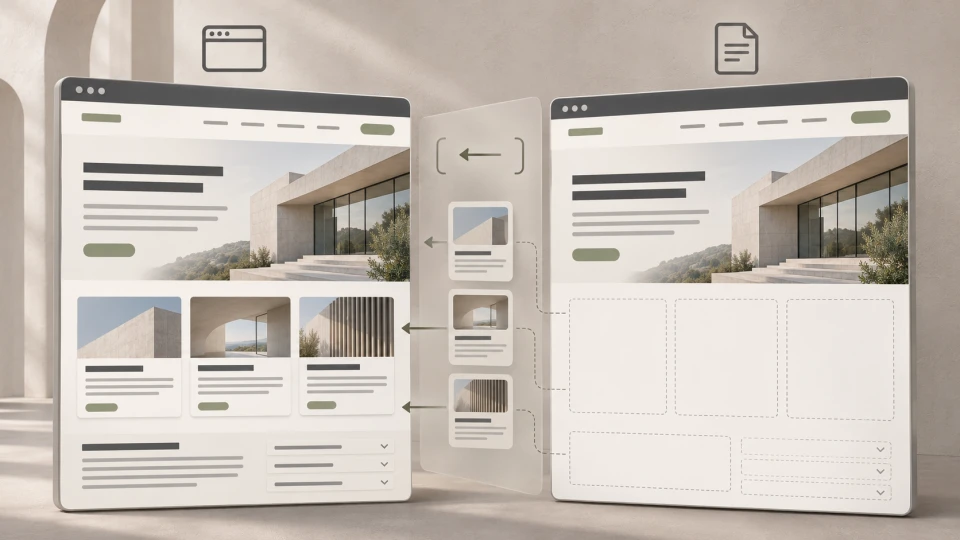
What Is B2B E-commerce?
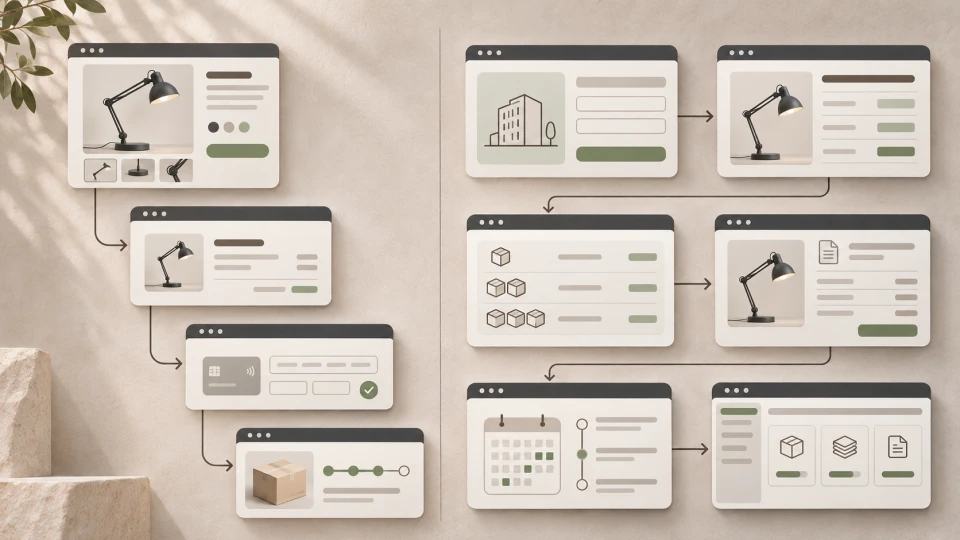
B2B e-commerce is the online sale of goods or services from one business to another. Unlike B2C e-commerce, where the buyer is a private individual, a B2B purchase is made for the needs of a company.
For example, a B2B transaction is when a construction company orders 100 sets of workwear online for its employees, while a B2C transaction is when a private individual buys one jacket for themselves.
From the outside, both online stores can look similar.
But the B2B buying process often requires:
- individual and volume pricing;
- quote requests;
- payment terms;
- company accounts with several users;
- quick and repeat orders;
- ERP, CRM or warehouse integrations.
B2B e-commerce is not simply a B2C online store where the buyer enters company details in the checkout form.
~ 8min
10/11/2026
What do B2B and B2C mean?
B2B stands for business-to-business.
For example:
manufacturer → wholesaler
wholesaler → retailer
materials supplier → construction company
B2C, on the other hand, stands for business-to-consumer.
In this model, a company sells a product or service to an end consumer for personal use.
B2B vs B2C - what is the difference?
The main difference is not the website itself.
What differs is the buying process.
| B2B | B2C | |
|---|---|---|
| Buyer | A company | A private individual |
| Order size | Often larger | Usually smaller |
| Price | May be specific to a customer or customer group | Usually the same for everyone |
| Discounts | Often based on volume or contract | Promotions and discount codes |
| Quote | A price quote may be needed | Usually buys at the listed price |
| Payment | Card, bank transfer, invoice, payment terms | Usually paid at the time of purchase |
| Users | Several people may represent one company | Usually one buyer |
| Orders | Often regular and repeated | More often one-off |
| Decision | Approval from several people may be needed | Usually made by the buyer alone |
| Integrations | ERP, CRM and warehouse are often important | Depend on the store's needs |
Not every B2B company needs all of these features.
The store's structure should reflect how the specific company actually sells to its customers.
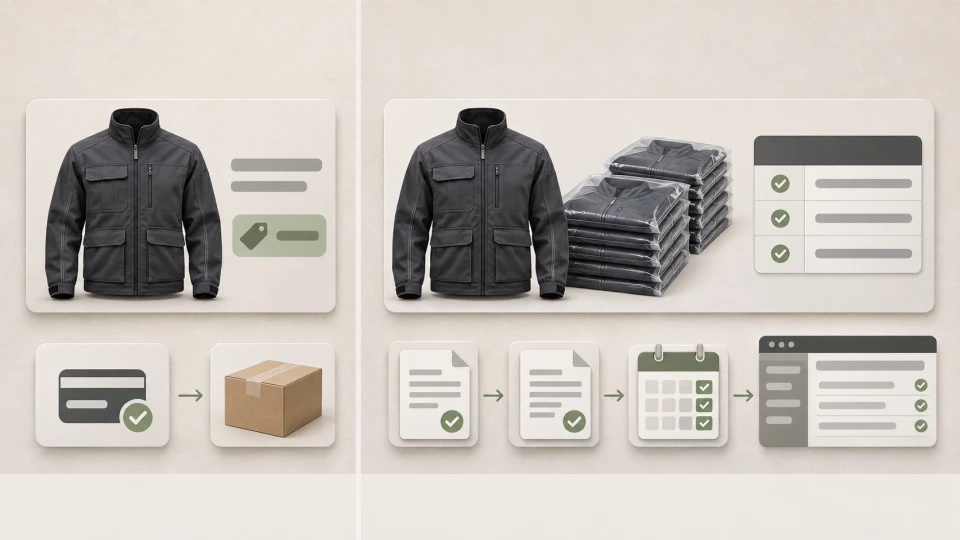
A practical example: the same product in B2C and B2B
Let's say a company sells workwear.
B2C customer
A private individual wants one work jacket:
finds the jacket → chooses a size → pays €79 → receives the item
B2B customer
A construction company wants workwear for 50 employees:
logs in to the company account
→ sees contract prices
→ selects the required sizes and quantities
→ gets a volume price
→ requests a quote
→ the seller approves the price
→ the customer enters a purchase order (PO) number
→ chooses 30-day payment terms
→ the order goes to the ERP.
The product can be the same.
The sales process is completely different.
That is exactly why B2B e-commerce development starts with understanding the business process, not just building a product catalogue.
Which features does a B2B online store need?
1. Individual and volume pricing
In a B2C store, a product's price is usually the same for everyone.
B2B customers may have:
- a standard price;
- a contract price;
- a price for a specific customer group;
- a volume price.
For example:
1-9 pcs → €10
10-49 pcs → €9
50+ pcs → €8
There may also be a minimum order or a requirement to order in full boxes or pallets.
After logging in, the customer can see exactly the price and purchase terms that apply to them.
This makes it possible to digitise pricing logic that the company would otherwise maintain in Excel files, emails or the ERP system.
2. Quotes and payment terms
Not every B2B product can be sold with a "Buy now" button.
If the price depends on quantity, configuration, delivery location or the customer's contract, you may need a feature like:
"Request a quote"
The customer selects products and quantities, the seller approves the price, and once agreed, the quote can be converted into an order.
Payment can also work differently in B2B.
For example:
- prepayment;
- 14 days;
- 30 days;
- 60 days.
A company may require prepayment from a new customer, while offering a long-term partner 30-day payment terms.
In this way, e-commerce digitises a process that would otherwise happen across emails, Excel files, invoices and phone calls.
3. Company accounts and multiple users
Legally, a B2B buyer may be one company, but several people use the system on its behalf.
For example:
ABC Ltd
may have:
- a procurement specialist;
- a warehouse manager;
- a project manager;
- an accountant;
- a company administrator.
Each may have different permissions.
One prepares the order, another approves it, and the accountant accesses the invoices.
B2B checkout may also require a PO number to link the order to the customer's internal purchasing process.
That is why, in more complex B2B e-commerce, an account is often tied not only to a person but also to a specific company.
4. Quick and repeat orders
For a B2C customer, product discovery is often important.
A B2B customer often already knows exactly what they want to order.
That is why the following can be valuable:
- quick-order forms;
- ordering by SKU;
- saved product lists;
- repeating previous orders.
If a company buys the same products every month, it should not have to start searching from scratch each time.
5. ERP, CRM and warehouse integrations
The value of B2B e-commerce drops sharply if, after every online order, an employee has to transfer data manually to other systems.
That is why the store can be connected to:
- an ERP;
- a CRM;
- a warehouse system;
- accounting;
- delivery systems.
For example:
ERP price → online store
stock level → online store
online store order → ERP
new customer → CRM
We cover planning an e-commerce solution in more detail in our online store development guide.
Does a B2B store have to hide its prices?
No.
Several models can be used.
Public prices
All visitors see the same price.
Public price + individual contract price
A visitor who is not logged in sees the standard price, while a B2B partner sees their own price after logging in.
Prices for registered customers only
The product catalogue is public, but prices are available only to approved business customers.
Quote only
If there is no single fixed price, the goal of the product page may be to generate a high-quality quote request.
The right model depends on how the company sets its prices today.
Is B2B e-commerce the same as wholesale?
Not always.
Wholesale is one of the B2B e-commerce models, where products are usually sold to other businesses in larger quantities.
But B2B can also include:
- direct sales from manufacturers to businesses;
- professional equipment;
- spare parts;
- regular business orders.
So not every B2B store is a classic wholesale store.
Can B2B and B2C be combined in one online store?
Yes.
For example:
B2C visitor
→ sees public prices and the standard checkout.
B2B customer after logging in
→ sees their own prices, volume discounts and payment terms.
This lets you maintain one product and warehouse system while offering a different buying experience to different customers.
However, this model needs to be planned into the store's architecture from the start.
When is it worth introducing B2B e-commerce?
A good signal is when the sales team regularly does manual work that customers could do themselves.
For example:
- orders arrive by email;
- sales reps check customer prices manually;
- customers regularly ask about stock levels;
- the same products are ordered again and again;
- quotes are prepared in Excel;
- orders have to be entered into the ERP manually.
In that case, the goal of B2B e-commerce is not just to "sell online".
The goal is to move repetitive sales processes into a self-service environment and reduce manual work on both sides.
When is a B2B online store not enough?
In some companies, the buying process is too individual for a classic checkout.
For example, if every deal requires:
- technical consultation;
- a custom specification;
- a calculation;
- negotiation;
- a contract.
Then a more suitable solution may be:
product catalogue → price quote → customer portal → CRM/ERP
B2B e-commerce does not mean every product must have a "Buy now" button.
Frequently asked questions
How is B2B e-commerce different from B2C?
The B2B buyer is a company, so the buying process more often requires individual prices, volume discounts, quotes, payment terms, multiple users and integrations.
The B2C buyer is a private individual, and the buying process is usually simpler.
Is B2B e-commerce only for large companies?
No.
It can also be valuable for a small or medium-sized company if it has regular business customers and much of its order processing is done manually.
The sales process itself matters more than the size of the company.
Does a B2B customer have to register?
Not always.
Registration becomes useful when the customer needs individual prices, order history, payment terms or other personalised functionality.
Does B2B e-commerce need a separate online store?
No.
B2B and B2C customers can be served in one system if it supports different prices, user permissions, catalogues and order terms.
A separate store may be justified if the two audiences' products, markets or sales processes differ significantly.
What are the most important features of a B2B online store?
It depends on the business model, but the most commonly needed are:
- business customer accounts;
- individual and volume pricing;
- price quotes;
- payment terms;
- quick and repeat orders;
- ERP, CRM or warehouse integrations.
Summary
B2B e-commerce is online selling between businesses.
But the most important difference from B2C is not just who the buyer is.
The buying process itself is different.
In B2C, this is often enough:
product → cart → payment
B2B may require:
company account → individual price → volume terms → quote → approval → payment terms → ERP
The same product can be sold in both models, but the system has to support a completely different buying logic.
Latest articles
What Is Conversion Rate Optimisation (CRO)?
WooCommerce or Shopify: Which Is Better for the Latvian Market?
From Fragmented Construction Procurement to a Scalable Platform: The TenderMap Case