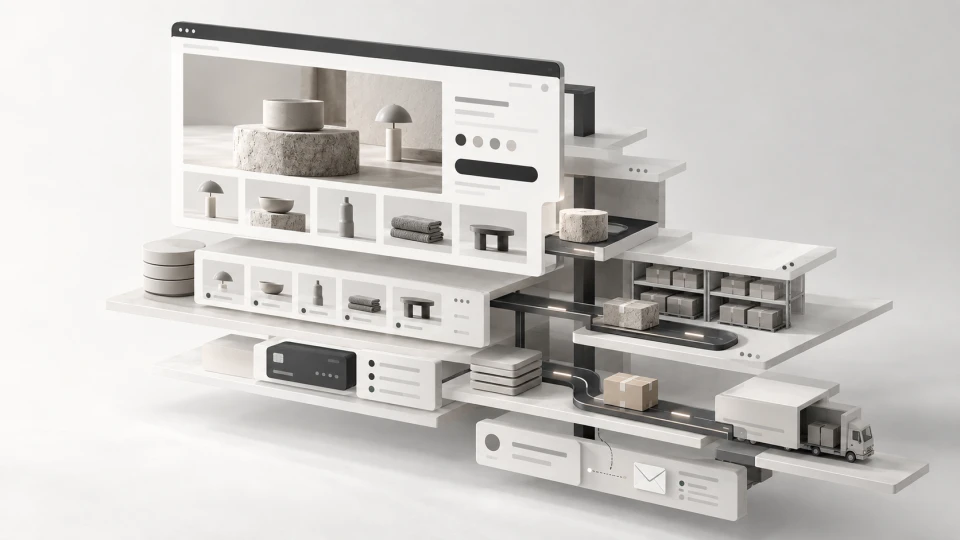
Business Website Creation: What to Plan Before Design and Development?
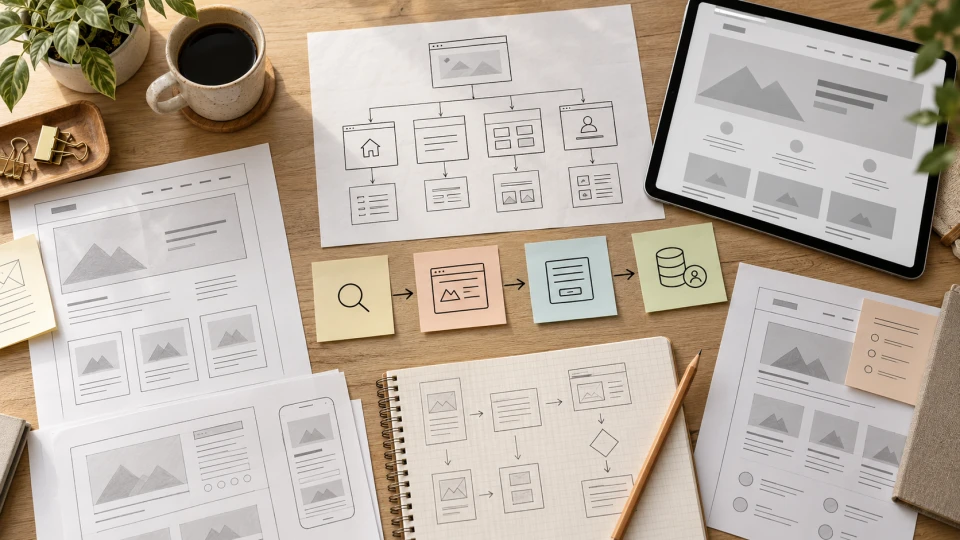
A business website should start with the business goal, audience, service structure and customer journey, not with design or platform selection. Before development begins, it should be clear what the website needs to achieve, how a visitor will move towards an enquiry, and what happens to that enquiry inside the sales process.
A professional website can become one of the company’s main customer acquisition channels, but only when structure, content, UX/UI, SEO and the technical solution work towards the same business objective.
That is why the first question should not be: “What design do we want?”
A much more useful question is: “What does this website actually need to achieve for the business?”
~ 12min
26/10/2026
Where Should You Start When Creating a Business Website?
Before the first design concepts are created, it is worth mapping three simple areas.
| Map | What needs to be defined |
|---|---|
| Offer map | What does the company sell, which services are most important, who are they for, and which offers are the business priorities? |
| Customer journey map | Where does the visitor come from, what do they need to understand, what information are they looking for, and what should the next step be? |
| Lead and data map | What happens after a form submission, call or booking? Where does the data go and who in the company is responsible for the next step? |
These three maps often reveal much more than a discussion about colours, animations or platform choice.
For example, a company may think it needs a new homepage, while the real issue turns out to be an unclear service structure, weak calls to action, or the fact that every enquiry lands in one inbox without a defined follow-up process.
That is why professional website development starts with understanding the business and user needs, not only with the visual solution.
How Should Services Be Structured So Both Customers and Search Engines Understand Them?
One of the most common problems on business websites is a structure that reflects the company’s internal organisation rather than the customer’s needs.
If a company offers five substantially different services but describes them all on one generic page, two problems appear.
The customer has to work harder to understand whether the company offers the right solution. At the same time, search engines have less clarity about which specific search intent the page should satisfy.
That is why each strategically important service should be evaluated as a potential standalone page with its own:
- customer problem and target audience;
- service explanation;
- benefits;
- process;
- examples or completed projects;
- frequently asked questions;
- call to action.
The goal is not to create as many pages as possible. The goal is to build a structure where every important customer need has a clear place.
SEO Starts Before Website Design
SEO should not be added only after the design and development work has already been completed.
Before UX/UI design begins, it is worth understanding what services people search for, how they phrase those searches, which pages currently rank in Google, and how the content should be structured so each priority topic has a relevant destination page.
This should then inform the sitemap, service hierarchy, URL structure and internal linking.
If the website is already live, an SEO audit and optimisation can help determine whether visibility is being limited by technical issues, content structure, site architecture, or a combination of factors.
What Does This Mean for AI Search?
AI-powered search systems can also interpret content more easily when each page has a clear topic and a specific purpose.
That means creating pages where each core service is clearly defined, important questions are answered directly, essential information is not hidden only inside visual elements, and real project examples support theoretical claims.
There is no need to write for an “AI algorithm”. The goal is to create content that a person, Google and an AI system can all understand clearly.
How Should a Website Turn a Visitor Into an Enquiry?
A visitor should not have to guess where to go or what to do next. A strong user journey answers a sequence of questions in the right order.
| Stage | What is the visitor thinking? | Website task |
|---|---|---|
| First impression | Am I in the right place? | Make the offer and audience immediately clear |
| Evaluation | Can they solve my problem? | Explain the service and approach |
| Trust | Why should I choose this company? | Show expertise, projects and proof |
| Decision | What should I do next? | Provide a clear call to action |
| Enquiry | How do I contact them? | Provide an easy form, call, booking or consultation option |
| After submission | What happens next? | Connect the enquiry to CRM, communication and the sales process |
A call to action does not have to be a generic “Contact us”.
Depending on the business model, it could be “Book a consultation”, “Request a proposal”, “Book a demo”, “Calculate the price”, “Send project details”, or another specific action.
The important point is that the visitor understands what will happen after they click.
The Contact Form Is Not the End of the Sales Process
Website conversion does not end when someone clicks “Submit”.
The business needs to know where the enquiry goes, who is responsible for it, which channel generated it, and how it will be handled afterwards.
In a simple setup, an email notification may be enough. In a more complex sales process, the website can be connected to CRM, analytics, email automation or other business systems.
For example: Google → service page → form → CRM → responsible salesperson → follow-up communication
The purpose of this kind of business system development and integration is not to connect as many tools as possible. The goal is to reduce repeated manual data entry and make the lead journey traceable.
This is particularly important for B2B companies, where the sales cycle rarely ends with a single website visit.
When Should You Improve an Existing Website and When Should You Rebuild It?
Not every problem requires a completely new website. Before rebuilding, it is worth identifying what in the current solution is actually preventing the business from reaching its goals.
| Situation | Often fixable without a rebuild | Rebuild worth considering |
|---|---|---|
| Unclear copy and offer | ✓ | |
| Weak calls to action | ✓ | |
| Missing dedicated service pages | ✓ | ✓ |
| Fragmented information architecture | ✓ | |
| Outdated technical foundation | ✓ | |
| Poor mobile usability | ✓ | ✓ |
| Required integrations cannot be implemented properly | ✓ | |
| Company positioning has changed significantly | ✓ | |
| SEO structure cannot be developed effectively | ✓ | ✓ |
A useful starting question is: “What will the new website be able to do that the current one cannot?”
If there is no clear answer, improving the existing website may be the more sensible first step.
WordPress or Custom Development?
Technology should follow the business requirements, not the other way around.
WordPress can be a strong fit for a business website where content, SEO, multilingual structure, straightforward administration and independent content management by the marketing team are important.
Custom development becomes more relevant when the website needs to behave more like a system, with specific business logic, user roles, complex data flows, a client portal or extensive integrations.
| Requirement | WordPress is often suitable | Custom development may be more suitable |
|---|---|---|
| Corporate website | ✓ | |
| Multilingual content | ✓ | ✓ |
| SEO and regular content publishing | ✓ | ✓ |
| Marketing landing pages | ✓ | ✓ |
| CRM/API integrations | ✓ | ✓ |
| Client portal | ✓ | |
| Complex user roles | ✓ | |
| Specific business logic | ✓ |
The platform itself is not a strategy. The right choice is the one that supports the company’s current needs and gives the solution room to develop in the future.
How Much Does a Business Website Cost?
The cost depends on much more than the number of pages or the visual design.
The scope of research, UX/UI, content structure, languages, CMS requirements, SEO, animations, integrations, migration, custom functionality and technical architecture can all affect the budget.
That is why two websites that look similar on the surface can represent very different levels of work.
Brandsite corporate website projects start from EUR 5,000, while the final budget depends on project scope, UX/UI, content structure, languages, SEO requirements, integrations and custom functionality.
For a more detailed breakdown, see the Brandsite guide “How Much Does Website Development Cost in 2026?”.
What Should Be Checked Before Publishing a Website?
A website is not finished just because the design looks right and every button can be clicked.
Before publication, it should also be tested as a customer acquisition and measurement system.
| Check | What to verify |
|---|---|
| Mobile version | Navigation, copy, forms, calls to action and key actions |
| Forms | Whether enquiries are sent and received correctly |
| CRM / email | Whether data reaches the correct system and responsible person |
| Analytics | GA4, GTM and key conversion events |
| Search Console | Property setup, sitemap and indexation monitoring |
| SEO | Title, meta, canonical, robots, structure and internal links |
| Redirects | Old URLs redirect correctly to the new destinations |
| Performance | Core pages have been checked on mobile devices |
| Languages | Correct URLs and language relationships |
| CTA | Every important page has a clear next step |
This stage is especially important when a new website replaces an existing one. Incorrect URL changes or missing redirects can damage organic visibility that has already been built over time.
What Happens After the Website Is Published?
Publication is not the end of the project. It is the point when real data about how people use the website starts to become available.
During the first weeks and months, it is worth analysing which pages attract organic traffic, which search queries bring users in, which pages generate enquiries, where visitors drop out, and whether calls to action work as expected.
This data allows the business to make much more precise decisions about future SEO, content, UX and conversion improvements.
A website should not be a static project that remains untouched for years. It should evolve together with the company’s offer, markets and customer behaviour.
What Can the Right Website Structure Change?
A website rebuild is not always primarily a visual project.
In one Brandsite project, the Roofmaster website ecosystem was restructured for three Baltic markets and five language versions. SEO was planned together with the technical architecture, content hierarchy, URL structure and market-specific content.
After the website restructuring and SEO work, the average organic position of priority keywords improved from around position 30 to the Top 5.
The important point is not only the ranking improvement. The case shows how closely SEO performance can be connected to the way the website itself is structured.
Read the full Roofmaster website restructuring and SEO case study.
What Should You Prepare Before Speaking to a Website Development Partner?
The clearer the business context, the more accurately the structure, functionality, timeline and budget can be planned.
| Question | What to prepare |
|---|---|
| Business goal | What the website needs to help the business achieve |
| Audience | Primary customer groups and markets |
| Services | Priority services and their hierarchy |
| Conversion | What action you want the visitor to take |
| Content | What already exists and what needs to be created |
| SEO | Current keywords, rankings and strategically important pages |
| Integrations | CRM, ERP, booking, analytics or other tools |
| Administration | Who in the company will manage the content |
| Existing website | What should be retained, migrated or improved |
| Future plans | Languages, markets, features and possible future development |
A good project brief does not have to be a 50-page technical specification.
It should help the development partner understand which business problem the solution needs to solve and what a successful outcome looks like.
Frequently Asked Questions
Where should you start when creating a website?
Start with the business goal, audience, service structure and user journey. Before design begins, it should be clear what a visitor needs to understand and what action you want them to take.
Should SEO be planned before website design?
Yes. Service hierarchy, URL structure, page topics and internal links affect both design structure and technical development. Adding SEO only at the end often means reworking decisions that have already been implemented.
Does a website need CRM integration?
Not always. In a simple sales process, a correctly configured enquiry form may be enough. CRM integration becomes valuable when the company needs structured lead management, source tracking, status management and follow-up sales activity.
WordPress or custom website development?
It depends on the required functionality. WordPress is suitable for many corporate website and content projects. Custom development is more often needed when the solution requires specific business logic, user roles, portals or complex data flows.
When is it better to improve an existing website instead of rebuilding it?
If the technical foundation is sound and the main issues are content, calls to action, SEO or specific UX details, the existing solution can often be improved. A rebuild becomes more justified when the limitations are rooted in the architecture, technology or overall site structure.
How long does it take to create a business website?
The timeline depends on project scope, content readiness, number of languages, functionality and integrations. Brandsite corporate website projects are often completed in approximately 4-8 weeks, while more complex solutions require a longer development period.
What is included in business website development?
Business website development typically includes understanding the business goals and audience, planning the site structure, UX/UI design, content and SEO architecture, technical development, analytics, testing and, where needed, CRM or other business system integrations.
A Successful Website Starts With the Right Questions
A business does not simply need a “new website”.
It needs a solution that helps customers understand the offer, find the right service, trust the company and take the next step.
For the company team, the website should be manageable, measurable and connected to sales and marketing processes.
At Brandsite, website projects start with understanding the business goal, audience, structure and required functionality. Only then do we define the UX/UI, technology and development approach.
Planning a new website or trying to determine whether your current website needs to be rebuilt?
Let’s start not with the technology, but with the question: what does the solution actually need to achieve? From there, we can define the right structure, functionality and development approach.
Book a consultation
Latest articles

Online store automation: how to connect e-commerce with ERP, CRM and delivery?

How to choose a website development company for your business project?

How to combine sales, rentals, services and CRM in one e-commerce system