SEO Audits: What They Reveal and When You Need One

An SEO audit is a structured review of a website that helps you understand what is limiting its visibility on Google: technical errors, indexing issues, poor page structure, weak or overlapping content, missing internal links, page speed or other factors.
If you are new to the topic, start with a simple explanation of what SEO is.
A good SEO audit is not a list of errors printed out by an automated tool. Its job is to determine which issues can actually affect organic visibility and what is worth fixing first.
For example, an audit tool may find dozens of technical signals, but what matters more to a business is understanding:
- whether Google can find the important pages;
- whether it can index them;
- whether the correct URL version is being indexed;
- whether the site structure helps convey the most important topics;
- whether the pages match what people actually search for;
- whether technical issues are holding the content back from reaching its potential.
Brandsite's SEO audit combines crawl data, Search Console, analytics and manual review to turn findings into a prioritised action plan.
~ 14min
02/11/2026
What does an SEO audit actually check?
An SEO audit usually covers several interconnected layers. A problem in one of them can affect all the others.
For example, a very good service page cannot reach its full organic visibility potential if Google cannot crawl or index the page correctly. On the other hand, a technically perfect page will not rank well on its own if its content does not answer the specific search intent.
1. Can Google find and index the important pages?
The first task of an SEO audit is to check whether search engines can access the pages that should appear in search results.
It is one of the core questions that technical SEO deals with.
The audit may check:
- HTTP status codes;
- robots.txt;
- noindex settings;
- the XML sitemap;
- canonical tags;
- 301 and other redirects;
- broken or 404 pages;
- pages with no internal links;
- duplicate URL versions.
The fact that Google has discovered a URL does not mean the page will definitely be indexed and shown in search results.
This becomes especially important after a website rebuild or platform change. If old URLs disappear without proper permanent redirects, some of the accumulated SEO signals may be lost. Google uses permanent 301 and 308 redirects as a strong signal pointing to the new target URL.
2. Does Google see the right version of the page?
Sometimes the same content can exist under several URL versions.
For example:
- URLs with parameters;
- filter pages;
- HTTP and HTTPS versions;
- an old and a new URL;
- very similar language or market pages.
This is where canonical tags become important.
The audit checks whether the site's technical configuration clearly indicates which URL is the preferred main version of the page.
Google uses several canonical signals, including redirects, rel="canonical" and sitemap data, but the final choice of canonical URL is made by Google itself.
3. Does the site structure help convey the content?
SEO is not just about optimising each page in isolation.
The site's overall information architecture matters too:
home page → service → specific service page → related article → next topical content
The audit helps spot:
- important pages buried too deep;
- pages without internal links;
- too many similar pages;
- a poorly thought-out category structure;
- unclear topic clusters;
- situations where several pages compete for the same search intent.
Internal links don't just help users navigate the site. They also help search engines find content and understand the relationships between pages.
4. Are the on-page SEO elements in order?
The audit also checks page-level elements:
- SEO title;
- meta description;
- H1;
- H2/H3 hierarchy;
- URL;
- image ALT text;
- internal links;
- structured data, where needed;
- duplicate or missing metadata.
Priority is what matters here.
A missing meta description is not automatically the most important SEO issue just because an audit tool flagged it as an error.
If, at the same time, an important service page is set to noindex or has no internal links at all, that may be a far more significant issue.
Prioritisation is exactly what separates an SEO audit from an automated list of errors.
5. Does the content match search intent?
An SEO audit should not look only at the technical code.
It should also check whether the page has a realistic chance of competing for the search query at all.
The audit may uncover:
- a service page that is too generic;
- an article that doesn't answer the main question clearly enough;
- several articles with very similar search intent;
- an important topic with no matching page on the site;
- old content that still gets impressions but few clicks;
- pages that already rank relatively well and have room for improvement.
That's why a thorough audit combines technical analysis with Search Console data and real user search behaviour.
6. Are several pages competing with each other?
Another issue can be the same search intent overlapping across several pages.
For example, a company might have:
- an SEO service page;
- a "What is SEO?" article;
- an article about SEO audits;
- an article about technical SEO.
They shouldn't all try to fill the same role.
A practical content architecture might look like this:
service intent → service page
definitional intent → glossary
how-to intent → practical pillar
comparison intent → comparison article
This separation helps define more clearly which page is meant for which search intent.
This article follows the same principle: the SEO audit service page stays focused on commercial intent, while this pillar answers the questions what an audit reveals and when you need one.
7. Is multilingual SEO set up correctly?
For Latvian companies, this is a particularly relevant part of the audit.
If a website has LV, EN, DE or other language versions, the audit checks:
- the URL structure of each language;
- hreflang;
- canonical tags;
- how the language versions link to each other;
- whether the content is localised;
- whether any language version is accidentally blocked;
- whether the right page version is served to the right market.
In a multilingual structure, it's not just about translation. What matters is the whole technical logic that helps search engines understand how pages relate to each other.
8. Is the website fast and stable enough?
An SEO audit may also cover Core Web Vitals and other performance metrics.
The main Core Web Vitals are:
- LCP - how fast the main content loads;
- INP - responsiveness to user interactions;
- CLS - visual stability.
Good thresholds are currently considered to be LCP up to 2.5 seconds, INP up to 200 ms and CLS up to 0.1, measured at the 75th percentile.
But an SEO audit is not an attempt to get a PageSpeed score of 100 at any cost.
What matters more is understanding whether a performance issue is significant enough to affect user experience and be a priority development task.
9. Does JavaScript affect access to key content?
Modern websites increasingly rely on JavaScript.
Google describes how it processes JavaScript pages in three main stages:
crawling → rendering → indexing.
This means that on some sites the initial HTML does not yet contain all the actual content, and Google only gets it after JavaScript runs during rendering.
Googlebot can execute JavaScript, but you shouldn't automatically assume that all search and AI crawlers process JavaScript content the same way Googlebot does.
Even Google's documentation notes that not all bots can run JavaScript, so server-side rendering or pre-rendering can still be a useful approach in certain projects.
That's why an audit should check whether the most important content and links are available even without full client-side JavaScript execution.
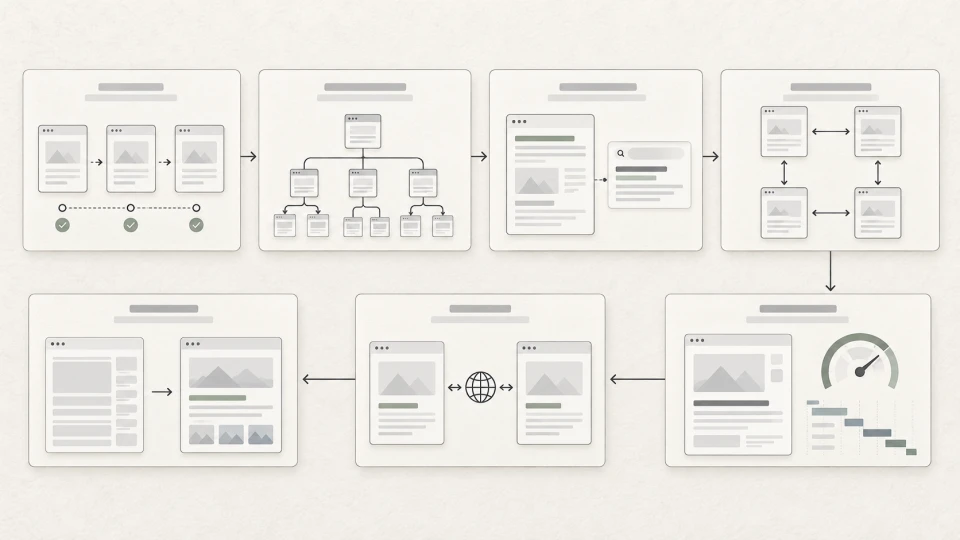
A real example: what Brandsite's own SEO audit revealed
On 25 October 2026, we ran an SEO audit of Brandsite's own website using Ahrefs Site Audit and additional manual analysis.
This example matters because an SEO audit isn't only for websites where "everything is bad".
Even a site that is actively worked on for SEO, with new content and an evolving structure, develops new technical and content opportunities over time.
One of the areas the audit prompted us to investigate in depth was content accessibility and the role of JavaScript from the perspective of different crawlers.
That raised the next question:
is the key content a person sees in the browser just as clearly available to the systems that crawl the page?
So rather than mechanically fixing every Ahrefs finding one by one, we separately checked how Brandsite's content is delivered in the initial HTML, how it becomes available after rendering, and where the technical implementation could affect content discovery.
That, in turn, became a separate line of technical research and content.
This is exactly how an audit should work:
the tool and data reveal a signal → we assess the potential impact → we set a priority → we test the solution
not:
the tool found lots of errors → we fix them all one by one
We don't quote a specific Ahrefs Health Score or number of errors here, because the value of an audit isn't in the tool's number. What matters more is the conclusion and how it shapes the work that follows.
An SEO audit is not the same as an Ahrefs report
Ahrefs Site Audit currently checks more than 170 technical and on-page SEO signals, including indexability, redirects, internal links, metadata, JavaScript, Core Web Vitals, sitemaps, structured data and more.
That's a very useful foundation.
But the tool doesn't know the full business context.
It doesn't know:
- which service page brings the company its most valuable enquiries;
- which market the company wants to grow next;
- which page is about to be rebuilt;
- whether a particular URL structure is a deliberate business decision;
- how complex a particular fix is;
- whether a technically correct solution is economically justified.
That's why the outcome of a professional audit shouldn't be just a long export of errors.
It should help answer the question:
What do we do first, why, and what problem does it solve?
How to prioritise SEO audit findings
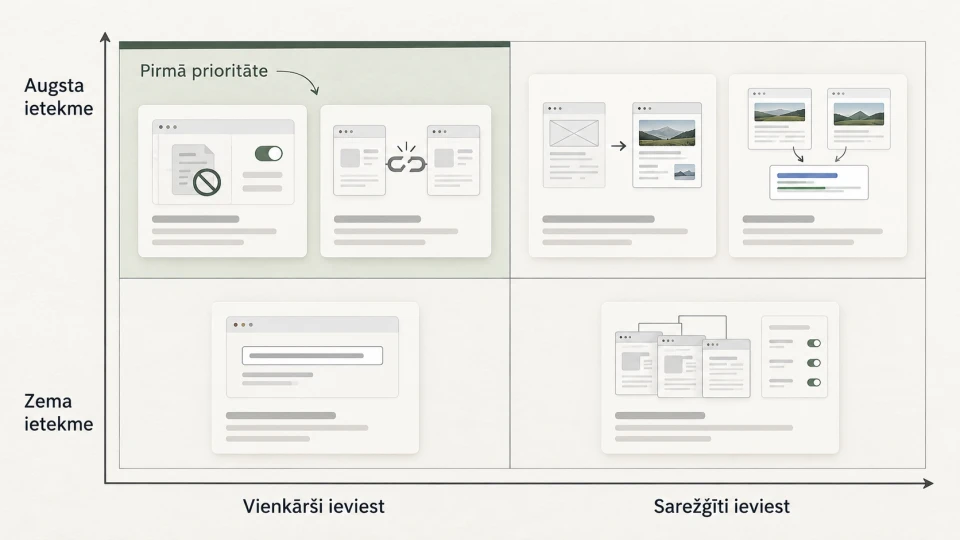
Audit issues can be grouped by two main criteria:
potential impact and implementation complexity.
| Lower implementation complexity | Higher implementation complexity | |
|---|---|---|
| High potential impact | Do first | Plan as a priority project |
| Lower potential impact | Fix when there is capacity | Often postpone |
For example:
High impact / relatively simple fix
- an important page is accidentally set to noindex;
- a key internal link points to a 404;
- a priority page has almost no internal links.
High impact / more complex fix
- incorrect multilingual architecture;
- a URL structure migration is needed;
- key content depends heavily on client-side JavaScript;
- several important pages overlap in search intent.
Lower priority
- a missing meta description on a minor page;
- a technical notice that, in the given situation, does not significantly affect indexing or users.
This kind of prioritisation helps avoid spending development time on something just because it's highlighted in red in the audit tool.
When do you need an SEO audit?
If organic traffic or rankings are dropping
If the drop is sudden, you shouldn't automatically assume the problem is a Google algorithm change.
First check:
- which pages lost clicks;
- which queries dropped;
- whether the drop coincides with technical changes;
- whether the pages are still being indexed;
- whether search intent or competition has changed.
Before a website rebuild or platform change
This is one of the most important times for an audit.
Before replacing the old site, you need to know:
- which URLs get organic traffic;
- which URLs have accumulated external or internal signals;
- which pages need to be kept;
- where 301 redirects are needed;
- what must not be lost in the new structure.
It's much safer to identify this before the migration than to discover problems after the new website goes live.
After a website migration or major structural change
An audit is valuable after launch too.
It checks whether the planned structure actually works:
- redirects;
- sitemap;
- canonical tags;
- indexing;
- robots;
- language versions;
- internal links.
If SEO has stalled for a long time
If content is being published but rankings and organic traffic barely change, an audit helps determine whether the limitation lies in:
- the technical foundation;
- content;
- structure;
- competition;
- authority;
- the wrong choice of keywords or search intent.
Before a larger SEO or content investment
There's little point spending months creating new articles if an important part of the website can't be indexed properly or the whole content architecture is disorganised.
An audit helps make sure new content is built on a technically and structurally solid foundation.
What does a company get after an SEO audit?
A good audit result is not just the number of errors found.
In practice, a company should receive:
- an explanation of the problem - what is wrong;
- the impact - why it matters;
- the priority - what to do first;
- the solution - how to fix the problem;
- ownership - whether it is an SEO, content or development task.
For example:
| Issue | Impact | Priority | Action |
|---|---|---|---|
| An important page is not indexable | The page cannot get organic traffic | High | Check noindex, robots and canonical |
| Several pages overlap on the same intent | The main URL is unclear | Medium / high | Review intent and consolidate content |
| Missing internal links to a new pillar page | The page is weakly connected to its cluster | Medium | Add contextual internal links |
| Missing meta description | May affect the search result snippet | Lower | Add for priority pages |
How does a Brandsite SEO audit work?
The Brandsite audit process has five stages.
1. We define the goal
We establish whether we need to address a traffic drop, indexing, a migration, an international SEO structure or another specific problem.
2. We collect data
We analyse Search Console, analytics, crawl data, PageSpeed, indexing and current rankings.
3. We audit
We check technical SEO, structure, internal links, metadata, content, hreflang and other elements relevant to the project.
4. We prioritise
We group the findings by potential impact and implementation complexity.
5. We prepare an action plan
We turn the results into specific tasks that can be implemented by Brandsite or the client's development and content team.
Frequently asked questions
How much does an SEO audit cost?
The price of an SEO audit depends on the size of the website, the number of languages and markets, the technical architecture and the depth of analysis required.
Before setting a price, the scope of the audit needs to be defined: whether only a technical audit is needed, or also content, keyword, competitor, multilingual SEO or migration analysis.
An audit of a small company website and an audit of an e-commerce system with several thousand URLs are projects of very different scope.
How often should you do an SEO audit?
There is no single universal interval.
For an active website where content, structure or the technical environment changes regularly, partial SEO checks can be useful every few months.
A full audit is more often justified after major changes or when Search Console, analytics or ranking data point to a possible problem.
Will an SEO audit improve Google rankings straight away?
No. An audit doesn't change rankings by itself.
It shows what is worth fixing.
Results come after the priority technical, structural or content improvements have been implemented and the search engine has recrawled and re-evaluated them.
Does an SEO audit also cover keywords and competitors?
That depends on the scope of the audit.
A basic audit can focus on the website's technical and structural condition. If the goal is a content and organic growth strategy, in-depth keyword, competitor and content-gap analysis can be added to the audit.
Do you need an SEO audit before a website rebuild?
Yes, especially if the existing site already has organic traffic or valuable rankings.
An audit helps you understand which URLs to keep, which need 301 redirects and how to avoid losing accumulated SEO signals on the new site.
What does an SEO audit give a business?
The value of an SEO audit is not in the number of errors. Its value lies in understanding what is really limiting organic visibility and what to fix first.
Sometimes the problem will be technical: indexing, redirects or JavaScript. Other times it will be in the content structure, the search intent, or in several pages trying to play the same role.
A good audit connects these signals with business priorities and turns them into a concrete work plan.