What Is AI SEO (AiSEO)?

AI SEO is the optimisation of a website, its content and its brand so that a company's information can be found, understood and used not only in traditional Google results, but also in AI-generated answers such as Google AI Mode, ChatGPT, Gemini and Perplexity.
Put simply: in classic SEO, the goal is often to get a specific page to appear in search results. AI SEO also looks at whether the company, its content and its information are found, used, cited or mentioned in AI-generated answers.
The spelling AiSEO is also used, but it is not an established industry acronym. AEO, GEO, LLMO and other terms are used alongside it.
That is why in this article we use AI SEO as a broad umbrella term.
More important than the acronym itself is the goal:
to be findable, understandable and trustworthy in an environment where users increasingly get a ready-made answer rather than just a list of links.
~ 11min
04/11/2026
Why did AI SEO emerge?
In traditional Google search, the user enters a query and gets a results page with links.
In AI search, the process can be different.
Someone might ask:
"Which CRM system should a Latvian company with 15 employees choose?"
and receive a summarised answer in which the AI:
- compares several options;
- explains the differences;
- draws on several sources of information;
- mentions specific companies or products;
- adds links to sources.
So the competition is no longer only about which URL ranks higher in the classic results.
Another question also becomes important:
does the AI system find and use information about our company or content at all when it builds an answer?
This layer of visibility is usually described with terms such as AI SEO, AEO or GEO.
Are AI SEO, AEO and GEO the same thing?
There is no single universally accepted definition of these terms, and in practice they overlap significantly.
| Term | What it usually means |
|---|---|
| SEO | Improving visibility in traditional organic search results |
| AI SEO | A broad term for optimising visibility in an AI-influenced search environment |
| AEO | Answer Engine Optimization - adapting content for direct-answer environments |
| GEO | Generative Engine Optimization - improving visibility, citations and mentions in generative AI answers |
AEO tends to emphasise clear, easy-to-use answers, while GEO focuses on visibility in generative answers.
But in practice these approaches overlap to a large extent.
If a website is technically inaccessible, its content is unclear and the company's information is not trustworthy, a new acronym won't solve the problem.
Does AI SEO replace classic SEO?
No.
Good SEO is the foundation of AI SEO.
AI SEO extends what we already do in SEO rather than replacing it.
It is still important that:
- the page can be crawled;
- the content is indexable;
- key information is available in the text;
- the website structure is clear;
- the content is useful and trustworthy.
Google AI Mode and AI Overviews don't require any special "AI SEO" markup or an entirely new optimisation layer.
The difference is that, in addition to classic rankings, we also start assessing:
how the company, the brand and its information appear in AI-generated answers.
What does AI SEO include in practice?
AI SEO is not one specific optimisation.
It combines several established SEO, content and brand authority disciplines.
1. Technical accessibility
First, the content has to be findable.
What matters:
- crawling;
- indexing;
- robots directives;
- canonicals;
- internal links;
- URL structure;
- JavaScript rendering.
If key information isn't available to the system trying to retrieve it, good text structure alone is not enough.
A particularly important question is what information is available in the initial HTML and what only becomes available after JavaScript has run.
2. Clear answers to specific questions
Both AI systems and people find it easier to use content when the answers in it are easy to find.
This doesn't mean writing text for robots.
It means that the information people need shouldn't be hidden behind several paragraphs of generic marketing copy.
For example, on a page about:
What is a CRM system?
the definition should be easy to find right at the start of the article.
This helps both search systems and users.
3. Original and verifiable information
Content that isn't simply retold from ten other articles becomes especially valuable.
For example:
- examples from your own projects;
- data;
- research;
- expert commentary;
- real processes;
- pricing information;
- clear comparisons;
- practical experience.
Generic content retold from other sources has a harder time standing out as a unique source of information.
A company's advantage is the information it can provide from its own experience.
4. Clear topical structure
AI SEO doesn't mean creating one huge article about the entire industry.
It is important to clearly separate different questions and search intents.
For example, in Brandsite's CRM cluster:
What is a CRM system?
→ definition
CRM systems in Latvia
→ comparison
How to connect a website to a CRM or ERP?
→ practical guide
Business systems integration
→ broader explanation of the topic
This kind of structure helps make clear:
- which topics the company has content on;
- which page answers a specific question;
- how the topics relate to each other.
5. Consistent and verifiable brand information
AI systems can gather information about a company from multiple public sources.
For example:
- the company's website;
- partner websites;
- industry publications;
- portfolio and case studies;
- business directories;
- review platforms;
- Google Business Profile.
What matters here is not following the principle "the more mentions, the better".
It is more important to avoid contradictory basic information.
If the company name, services, location or other key details differ across public sources, it becomes harder for both AI systems and people to form a consistent picture of the company.
Is structured data part of AI SEO?
Structured data can help systems understand specific page elements more precisely, but it is not a special AI SEO trick.
There is no special:
- AISEO schema;
- GEO Schema.org type;
- dedicated AI structured-data markup
that you need in order to appear in Google AI Mode or AI Overviews.
Structured data is still worth using where it matches the type of content itself.
However:
structured data won't fix weak content, technical inaccessibility or a lack of trust.
Does AI SEO mean using AI in SEO work?
Not necessarily.
These are two different concepts.
In this article, AI SEO means optimising visibility in AI search and generative answer environments.
Using AI in SEO work, on the other hand, means that artificial intelligence helps analyse data, group keywords, prepare content, monitor results or carry out other SEO tasks.
Related to this is the term "AI SEO employee", or AI SEO agent, which you'll find on the market and which we explain in more detail in the FAQ.
Do you need llms.txt or special AI files?
For Google AI search - no.
Google's AI features don't require:
- llms.txt;
- a special AI text file;
- dedicated AI markup;
- a special AI Schema.org type.
This doesn't mean that all AI platforms always work in exactly the same way.
But there is no reason to implement a technical element just because it is being marketed as a mandatory "GEO solution".
Get the fundamentals right first:
technical accessibility → quality content → clear structure → trustworthy information
What does AI SEO look like in practice?
Let's say a company wants to be visible when a potential client asks an AI system:
"Which CRM system should a small business in Latvia choose?"
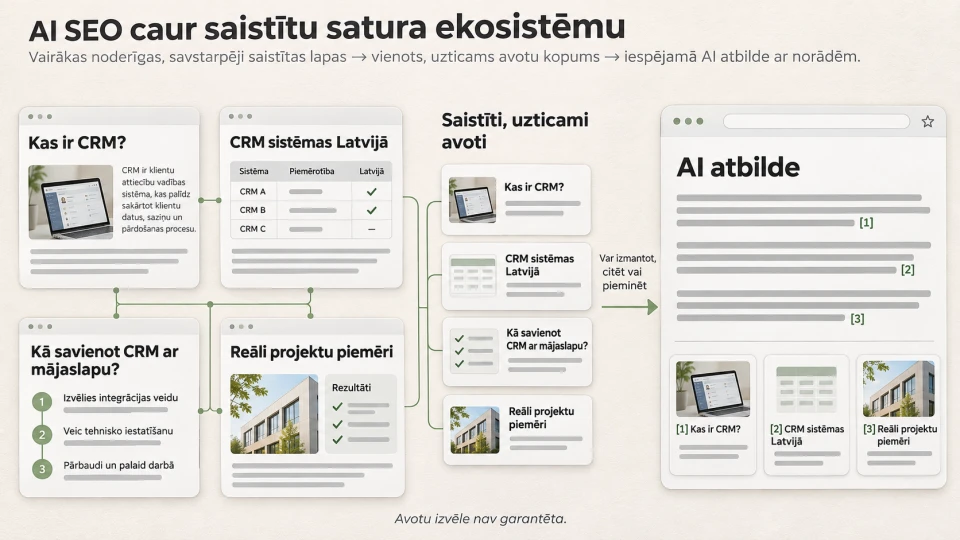
A single page is not enough:
best CRM system
A much more valuable content structure might be:
What is a CRM system?
→ explains the core concept
CRM systems in Latvia
→ compares the options
How to connect a CRM to a website?
→ explains practical implementation
Real integration examples
→ shows experience
As a result, the company doesn't just create one page for one keyword, but several interlinked sources on the topic.
This is exactly where SEO, content strategy and AI visibility start to overlap.
How do you measure AI SEO results?
AI SEO can't be properly assessed by Google rankings alone.
Depending on the platform and the tools available, you can analyse:
- brand mentions in AI answers;
- citations;
- URLs used as sources;
- visibility compared with competitors for specific questions;
- traffic from AI platforms;
- leads or sales from that traffic.
Visibility in Google's generative AI search can also be analysed in Search Console data.
For external AI platforms, you often need separate monitoring tools or a set of questions you check regularly.
An important nuance:
AI answers are not as stable as a traditional list of rankings.
The same question can produce different wording, sources or mentions at different times.
That is why it is better to assess the trend across several questions over a longer period rather than a single lucky screenshot.
What can AI SEO not guarantee?
No one can guarantee:
- a specific mention in ChatGPT;
- a specific citation in Google AI Mode;
- a specific position in an AI answer;
- that one particular page will always be used as a source.
AI system results are dynamic, and different platforms use different systems and sources of information.
So the goal of AI SEO is not:
"to force AI to recommend us".
The goal is to increase the chance that the company and its content are technically accessible, understandable, trustworthy and valuable enough to be used when an answer is generated.
Frequently asked questions
What is AI SEO?
AI SEO is the optimisation of a website, its content and its brand for visibility in AI-influenced search and generated answers.
It complements traditional SEO rather than replacing it.
Is AiSEO the same as AI SEO?
AiSEO can be found as an alternative spelling, but it is not an established industry acronym.
AISEO is also used in the names of some products and companies.
That is why in this article we use AI SEO as the main term.
Are AI SEO, AEO and GEO the same thing?
Not quite, but the terms overlap significantly.
AEO usually puts more emphasis on visibility in direct answers, GEO on generative answers, while AI SEO can be used as a broader umbrella term.
There is currently no unified terminology in the industry.
Will AI SEO replace SEO?
No.
Traditional SEO still provides technical accessibility, indexing, content structure and other fundamentals that also matter in AI search.
AI SEO rather extends SEO to new ways of finding and presenting information.
Can you optimise a website for ChatGPT?
You can improve the preconditions so that the website's information is technically accessible, clear, trustworthy and usable by AI systems.
But you can't guarantee that ChatGPT will use or mention a specific company in a particular answer.
Is AI-generated content AI SEO?
No.
AI SEO describes a visibility goal, not the tool used to create the content.
AI can help with content creation, but automatically generated text doesn't become AI SEO on its own and gives no guaranteed advantage in AI search.
What is an AI SEO employee?
"AI SEO employee" is not a standardised industry term.
It is a label found on the market for agentic SEO automation - a system that carries out SEO tasks autonomously or semi-autonomously.
For example, an AI SEO agent can:
- analyse Search Console data;
- look for content opportunities;
- prepare SEO tasks;
- monitor results;
- automate part of the repetitive SEO work.
In short:
AI SEO = a visibility goal
AI SEO employee = a tool or agent that automates SEO work
Does AI SEO require llms.txt?
For Google's generative AI search features - no.
Google states that special AI files or dedicated markup are not required for content to appear in its AI search features.
Summary
AI SEO is the work of making a company's content and information findable, understandable and trustworthy in AI-generated search answers as well.
But it is not an entirely new replacement for SEO.
Many of the fundamentals stay the same:
technical accessibility → useful content → clear structure → real expertise → trustworthy information
What changes is the environment in which this information reaches people.
In traditional search, we often asked:
"Does our page appear?"
In AI search, we need to add one more question:
"Does our company's information become part of the answer?"