From Fragmented Construction Procurement to a Scalable Platform: The TenderMap Case
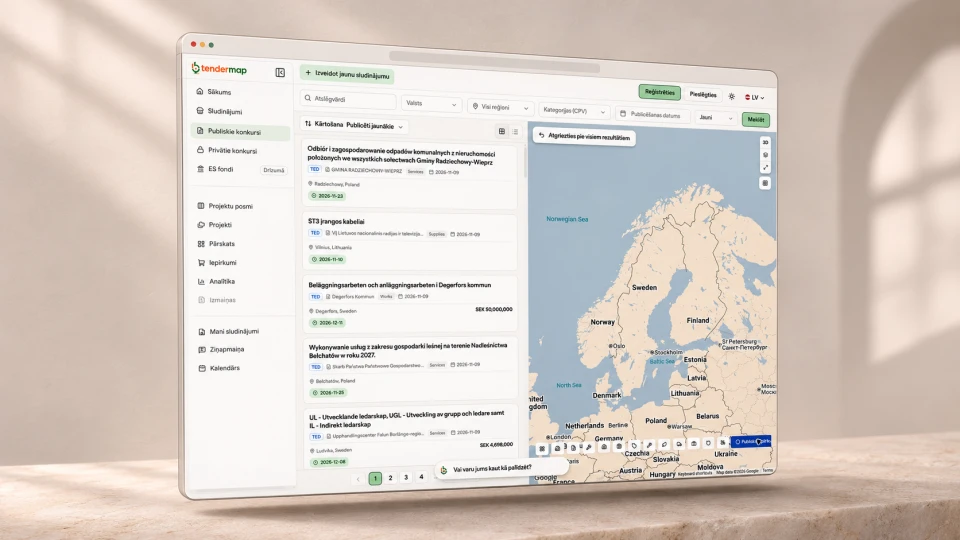
In the construction market, information about projects, service providers, machinery and suppliers is often spread across different platforms, contacts and manual processes.
The idea behind TenderMap was to replace this fragmentation with a single digital environment.
Brandsite's task was not to build an ordinary company website. What was needed was a custom web application with its own business logic, location-based search, several user types, payments and a multilingual architecture.
In 2025, Brandsite developed TenderMap's initial platform with Laravel. The development took around 8 months.
Since then, the TenderMap product has grown significantly.
Today, TenderMap itself publicly reports more than 1,500 companies, 12,000+ active projects and operations in 8 countries.
These figures describe TenderMap's current platform scale, not automatically the result of Brandsite's development phase.
~ 7min
09/11/2026
The problem: the construction market is local, but information is fragmented
In construction, location has a direct impact on cost.
If a project needs:
- a crane;
- an electrician;
- a materials supplier;
- equipment rental;
- a subcontractor,
distance can affect the transport price, delivery time and the overall cost of the project.
That is why a classic business directory alone was not enough.
TenderMap had to connect:
service → location → user → offer → payment → market
in one digital system.
This meant the project could not start with design mock-ups alone.
First, we had to understand:
- who would use the platform;
- how their permissions would differ;
- how services would be found;
- what data would need to be stored;
- how payments would work;
- how the platform could be expanded to other markets.
The approach: location became part of the platform's business logic
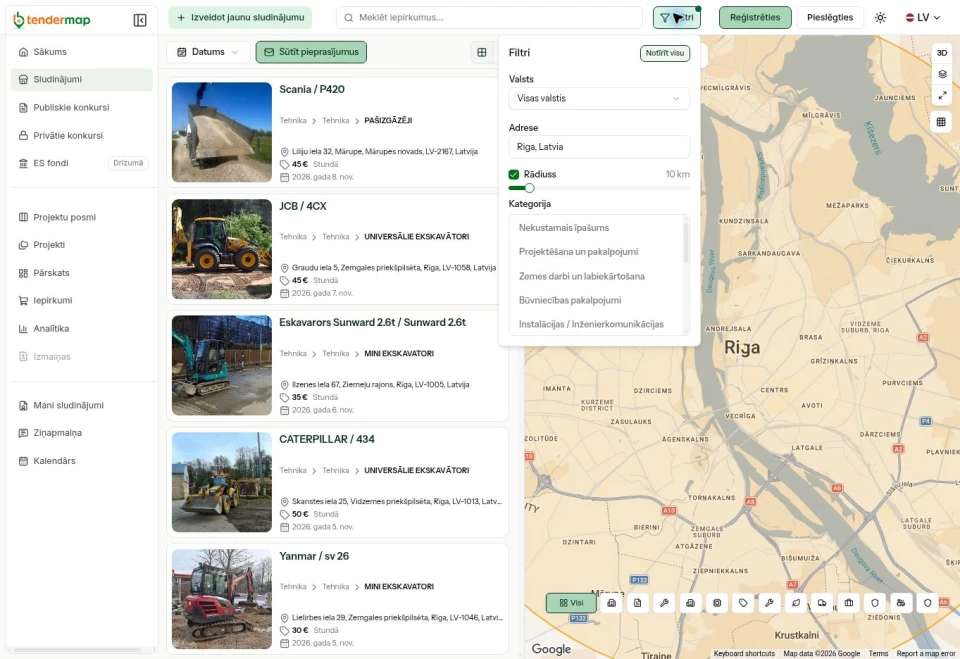
One of the key elements of the initial TenderMap solution was geographic search.
Users needed to be able not only to choose a category, but to find relevant services within a specific area.
The flow was designed roughly like this:
choose a need → set a location or radius → see results on a map → filter the relevant offers
This is very different from an ordinary directory.
Location becomes part of:
- the data structure;
- filtering;
- result prioritisation;
- the user experience;
- the platform's business logic.
Several user types in one system
TenderMap was not designed for a single universal user.
The initial platform included different profiles and access levels, including free and paid users, as well as an admin area.
This means that after login, the system has to understand:
who the user is → what they can see → what they can do → what data changes after an action
Projects like this are exactly where web application development differs from classic website development.
On a website, the main task is often presenting information.
In a web application, the system itself becomes the working environment.
9 languages built into the initial architecture
TenderMap was planned for several markets from the very start of the project.
The solution developed by Brandsite supported 9 language versions.
In a multilingual web application, this is not just a matter of translating text.
You also need to consider:
- the interface;
- categories;
- filters;
- system notifications;
- user profiles;
- regional data;
- payments;
- the admin area.
If internationalisation is added only at the end of a project, the data and system architecture may also have to change.
That is why TenderMap's scalability had to be planned in the initial development phase.
Laravel as the foundation for custom business logic
TenderMap was developed with Laravel.
The technology was used to support:
- the user system;
- the database;
- custom business logic;
- payments;
- geographic search;
- administration;
- further platform development.
The initial development of the project took around 8 months.
But the name Laravel is not what matters most.
What matters most is whether the architecture can grow together with the product:
more users → more data → more markets → new features → new integrations
The result of Brandsite's development phase
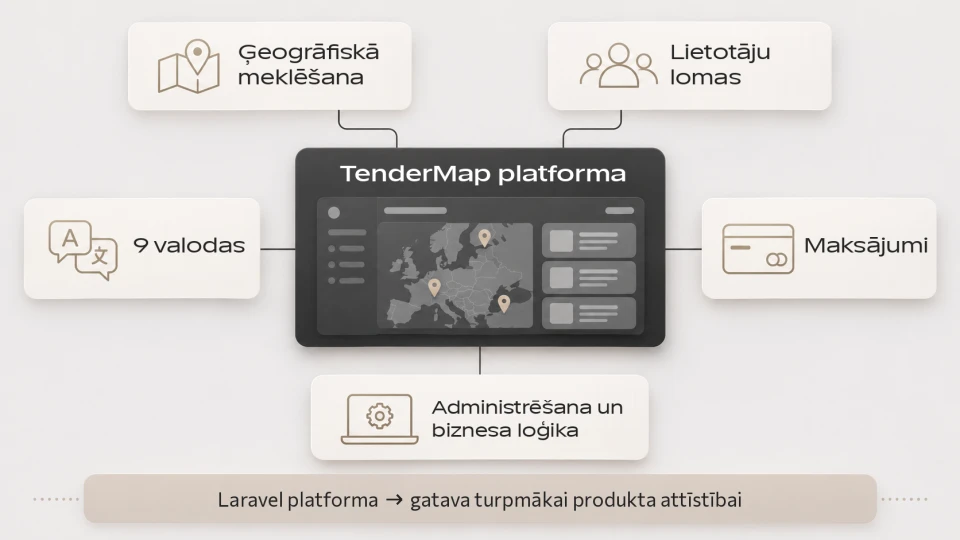
In the initial TenderMap project, Brandsite built a technical foundation that combined:
a Laravel web application
→ location-based search
→ an interactive map and filtering
→ several user types
→ 9 languages
→ payment flows
→ admin functionality
This is the result that can be directly attributed to Brandsite's development phase.
It does not tell you how many companies registered later or how much procurement value was processed.
Those are separate business results that need to be assessed together with TenderMap.
What happened next: TenderMap today
Since the initial platform was developed, the TenderMap product has continued to evolve.
Today, TenderMap positions itself as a broader construction procurement, supplier and marketplace environment.
TenderMap publicly reports:
| Metric | Scale currently reported publicly by TenderMap |
|---|---|
| Companies | 1,500+ |
| Active projects | 12,000+ |
| Markets | 8 countries |
| Languages | 9 |
| Workflow improvement | up to 5x faster |
| AI matching | 94% accuracy |
| 2026 procurement value shown on the platform | €2.8B |
Important: these are platform metrics currently communicated publicly by TenderMap, not results of Brandsite's development phase.
From a map and marketplace to an AI procurement environment
TenderMap's current platform is broader than Brandsite's initial project phase.
The product now also communicates AI features:
- matching suitable tenders;
- bid analysis;
- calculations;
- legal and contract analysis;
- risk assessment.
On its website, TenderMap also publicly reports 94% AI matching accuracy.
This is a TenderMap product metric, not a Brandsite development KPI.
But it illustrates one important principle of digital product architecture:
when building a platform from the start, you need to leave room for features that do not yet exist in the first version of the product.
What can other companies learn from TenderMap?
The TenderMap example shows well when a standard website or a ready-made marketplace template can become a limitation.
A custom web application becomes more justified when you need to combine:
- different user roles;
- custom user data;
- complex search;
- maps and location data;
- payments;
- access levels;
- several markets;
- custom business logic;
- future integrations.
Another principle matters too:
a digital product does not need to try to build everything possible in its first version.
It is far more important to build an architecture that can evolve together with real user and business needs.
The result: a technical foundation for a digital product
The strongest part of the TenderMap story is not a specific number of screens or features.
In Brandsite's development phase, a foundation was built for a digital product with:
geographic search → several user types → 9 languages → payments → custom business logic
Today, TenderMap publicly communicates a much broader product and scale.
It is a good example of how a web application can become not a company's digital business card, but the technical foundation of the business product itself.
You can view the TenderMap project in the Brandsite portfolio.
Is a standard website enough for your business idea?
Not every company needs a custom web application.
It becomes justified when a ready-made solution can no longer support your specific:
- business process;
- user roles;
- data flows;
- payments;
- integrations;
- scaling plan.
Brandsite develops custom web applications, portals and business platforms with Laravel, databases, APIs, user roles, payments and custom business logic.